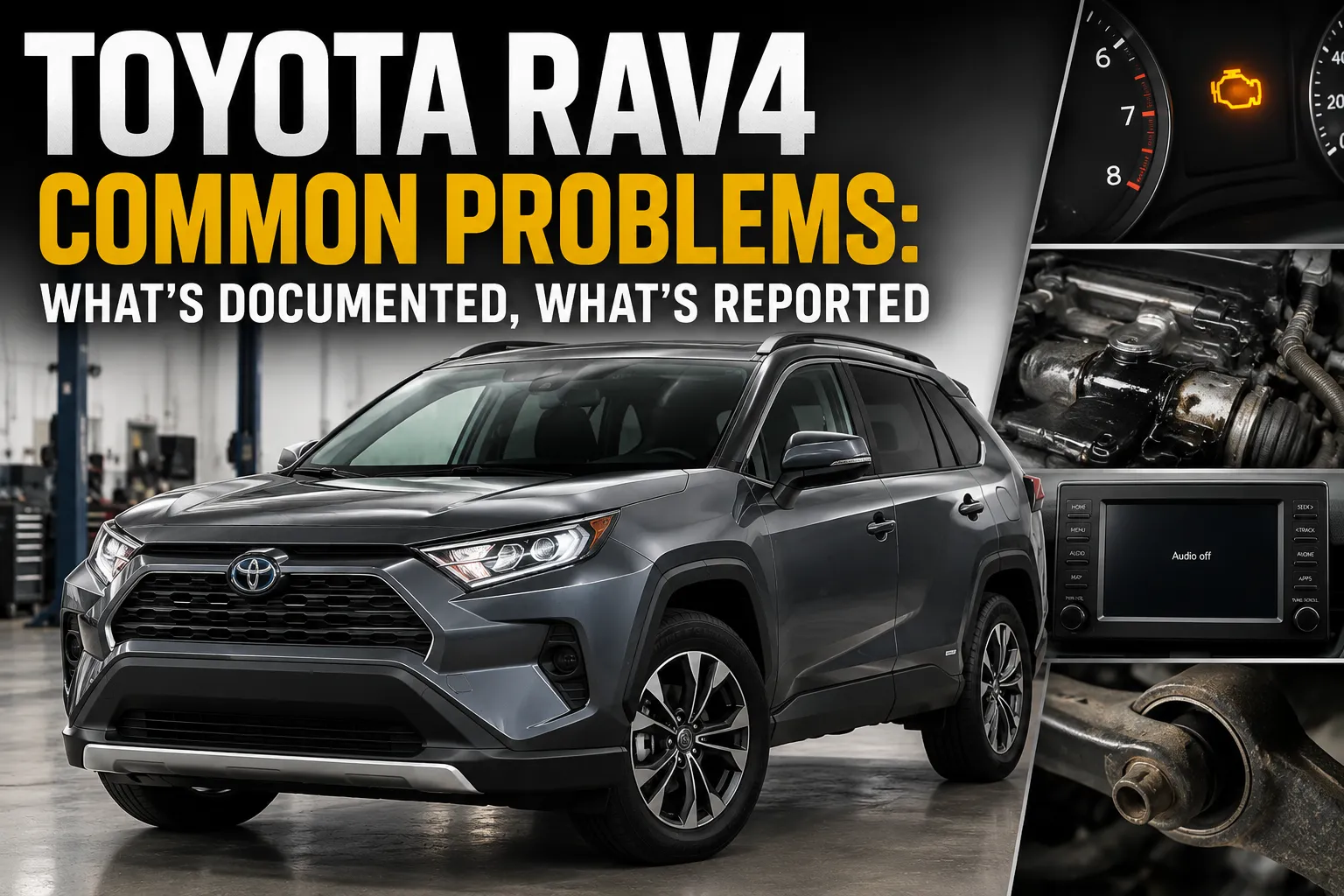

The RAV4 is America’s best-selling SUV and, by most measures, one of the most dependable ways to buy one. But “reliable overall” doesn’t mean problem-free, and if you’re researching a used RAV4 you deserve better than a pile of anonymous complaints. This guide sorts every significant RAV4 problem by what Toyota has actually documented — recalls, warranty programs, service bulletins — versus what owners report, with the exact years affected and how to check a specific car. For which years to buy, pair this with our RAV4 best-years guide.
The one rule that makes this useful
A recall is not proof a model is unreliable — it’s a documented, fixable, usually VIN-specific defect with a free remedy. An owner complaint is not a failure rate. Keeping those straight is how you avoid both traps: dismissing real issues and panicking over noise. That discipline is the same one behind our Toyota reliability coverage by model.
Documented problems (Toyota’s own record)
1. Excessive oil consumption — 2006–2008 2.4L (2AZ-FE)
The most consequential older-RAV4 issue. The 2.4L 2AZ-FE’s piston-ring design can burn oil at a rate Toyota’s own dealer test defines as a problem (roughly a quart every 1,200 miles or worse). Toyota documented it in TSB-0094-11 and covered qualifying engines under its ZE7-family warranty enhancement — the same program family that covered the Camry and Corolla 2AZ engines. That coverage has long expired by age, so today this is a condition question: check the dipstick, ask how often the owner tops up, and favor cars with a documented piston/ring repair. Unchecked, low oil can destroy the engine; managed, these cars can still serve. The 2009+ 2.5L (2AR-FE) does not carry this pattern.
2. Fuel pump that can fail and stall — certain 2019–2020
Certain 2019–2020 RAV4s are covered by the industry-wide Denso low-pressure fuel-pump recall (expansion campaign 20V-682) — the same family of campaigns that touched the Highlander and other Toyotas. A failing pump can stall the engine. The remedy is a free pump replacement; the coverage is VIN-specific, so run the VIN through Toyota’s and NHTSA’s lookup rather than assuming.
3. Engine block casting porosity → coolant leak — certain 2019–2020
Recall 20V-064 covers roughly 44,000 Toyota/Lexus 2.5L engines — including certain 2019–2020 RAV4 and RAV4 Hybrid — whose block casting could crack and leak coolant, with engine replacement as the remedy on affected VINs. Serious-sounding, tightly scoped, and fully fixable: confirm by VIN, and on any 2019–2020 look for coolant stains or a sweet smell under the hood.
4. Front lower suspension arm — certain 2019–2020
Recall 20V-286: a front lower suspension arm on certain 2019–2020 cars could crack and, in the worst case, separate. Free inspection/replacement; VIN-specific.
5. Roof-rail water leaks — certain 2019–2021
Toyota’s Customer Support Program 22TE05 covers verified roof-rail water leaks on certain 2019–2021 RAV4/RAV4 Hybrid and certain 2021 Prime vehicles. Note the tier: a support program, not a recall. On any early fifth-gen car, check the headliner and carpets for water staining and ask whether 22TE05 work was performed.
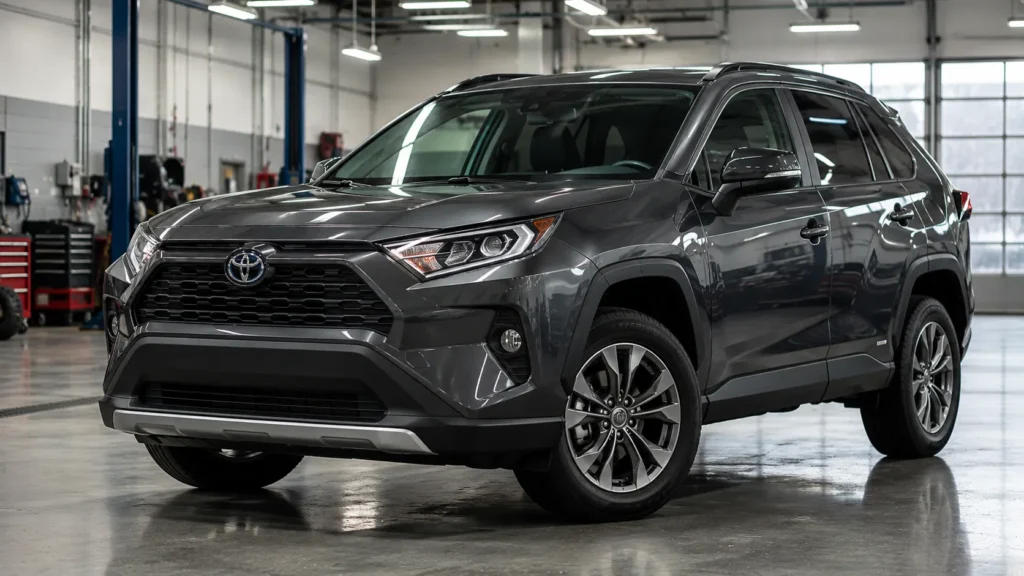
RAV4 Problems at a Glance
| Car Name |
Spec Label
|
spec value
|
|---|---|---|
| 2006–2008 (2.4L) | Issue / Tier / Action | Oil consumption / Documented (TSB-0094-11, ZE7 family) / Dipstick + records |
| 2013–2018 | Issue / Tier / Action | Infotainment gripes / Reported / Test head unit |
| 2019–2020 | Issue / Tier / Action | Fuel pump, block casting, suspension arm / Documented recalls (VIN-specific) / VIN lookup |
| 2019–2021 | Issue / Tier / Action | Roof-rail leaks / Documented CSP 22TE05 / Check headliner |
| 2019 | Issue / Tier / Action | Shift hesitation / Reported (TSB) / Parking-lot test drive |
Reported problems (real patterns, no defect finding)
2019’s harsh, hesitant shifting
The fifth generation’s first year drew a consistent owner-complaint pattern: low-speed hesitation followed by a lurch from the 8-speed automatic. Toyota addressed it with an ECM-reprogram service bulletin — not a recall — and 2020-onward cars show far fewer complaints. On a 2019 test drive, creep through parking-lot speeds and light throttle tip-in; if it’s clunky, ask a dealer to confirm the TSB software status.
Age-and-wear items on 2006–2012 cars
Water pump leaks (whining, coolant loss, typically after ~80k miles) and a clunking steering intermediate shaft are the third generation’s classic wear items — repair-cost realities of older cars rather than year-specific defects. Ignition coils and general suspension wear round out the list. Price the car accordingly.
Infotainment gripes on 2013–2018 cars
Unresponsive touchscreens, reboots, and Bluetooth dropouts are the fourth generation’s most common complaints — annoying, software-patched in part, and irrelevant to the drivetrain. Test everything on the head unit before buying; don’t let it veto an otherwise excellent car.
- Modern platform, standard TSS, strong crash scores and resale.
- Every documented issue has a free, VIN-checkable remedy (20V-682, 20V-064, 20V-286; CSP 22TE05).
- 2020 onward shows markedly fewer shifting complaints after software updates.
- Three separate VIN-specific recalls plus a leak program concentrate in these years — more homework than a typical Toyota.
- 2019 shift hesitation is Reported/TSB-tier — test drive carefully.
What about the hybrid?
The RAV4 Hybrid’s record is strong — and note that some of the documented items above (fuel pump, block casting, roof rails) list hybrid VINs within their scope, so the VIN check applies regardless of powertrain. The high-voltage battery itself is a long-life component; if that’s your worry, read how long Toyota hybrid batteries last.
The 10-minute pre-purchase check
- Run the VIN through Toyota’s and NHTSA’s recall lookups (fuel pump 20V-682, block 20V-064, suspension arm 20V-286 on 2019–2020; all open recalls on any year).
- 2006–2008 2.4L: dipstick level, top-up history, any piston/ring repair records (TSB-0094-11 / ZE7-family).
- 2019–2021: headliner/carpet water staining; ask about CSP 22TE05.
- 2019: parking-lot test drive for shift hesitation; TSB software status.
- 2006–2012: coolant leaks/water-pump whine; steering clunk over low-speed bumps.
- All years: consistent service records — still the best predictor there is.
Bottom line
The RAV4’s problem list is short, specific, and mostly checkable in an afternoon — which is exactly why it remains one of the safest used buys in the class. Verify the documented items by VIN, test for the reported ones, and buy on condition. For year-by-year verdicts, see the best-years guide; if you’re weighing the segment rival, our RAV4 vs Honda CR-V comparison completes the picture.