
Type “CR-V problems” into a search box and you’ll get two kinds of answers: breathless lists that make Honda’s best-seller sound like a lemon, and fan-forum reassurance that nothing ever goes wrong. Neither helps you buy a car. The truth sits in the middle, and it’s surprisingly tidy — the CR-V has one problem Honda formally acknowledged with its checkbook, three or four patterns owners keep reporting, and a long list of noise.
Here’s the full picture, sorted by how solid the evidence actually is. If you want year-by-year buying verdicts instead, that’s our CR-V best and worst years guide — this page is the diagnostic companion.
The big one: oil dilution in the 1.5L turbo
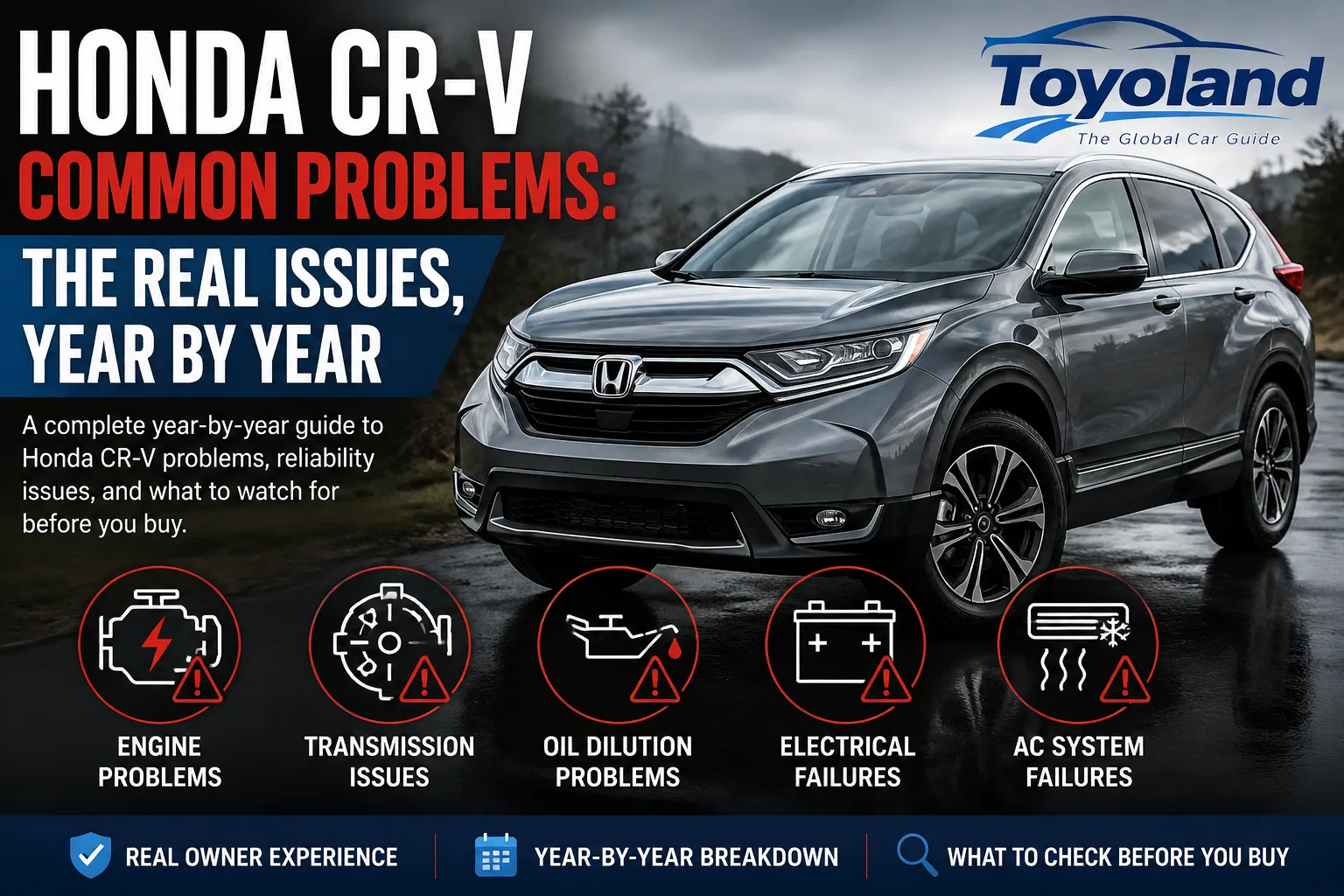
If you remember one thing from this page, make it this. On the fifth-generation CR-V’s 1.5-liter turbo (2017 onward, standard on everything but the base LX), unburned fuel can wash past the piston rings during cold starts and short trips and end up in the oil. The oil level creeps up the dipstick instead of down, and it starts smelling like a gas station. Thin oil protects worse, and in cold climates the effect compounds.
Honda didn’t just shrug. It issued a string of software bulletins — 18-089 was the big one, retuning injection timing and warm-up behavior, with 19-032 and 19-037 following — and then did the thing manufacturers only do when a problem is real: it extended the powertrain warranty to six years with unlimited mileage on the affected engine components, covering every 2017–2018 CR-V with the 1.5T. That’s over a million vehicles once you add the Civics that shared the engine. Worth being precise about what it wasn’t, though: never a safety recall, and Honda maintained the issue was rare. Complaints did continue at lower rates into 2019–2022 cars, and class-action lawyers picked that thread up — but that later chapter is owner reports and legal claims, not another Honda program.
What you actually do about it: pull the dipstick on any 1.5T you’re considering. Over-full or gassy-smelling oil is your answer right there. Ask a Honda dealer to confirm the software updates by VIN, favor warm-climate or highway-driven cars, and look for shorter oil-change intervals in the records — that’s the practical mitigation owners landed on. Or skip the question entirely: the 2.4L LX of those years and every hybrid CR-V simply don’t have this conversation.
- Fully documented and checkable — dipstick, TSB status by VIN, oil-change records.
- Honda's warranty extension covered all 2017–2018 1.5T CR-Vs; later software came factory-applied.
- Post-2020 cars show markedly fewer complaints.
- Worst in cold climates and short trips — exactly the histories hardest to verify.
- Later-year claims live in litigation, not a Honda program — condition is your only warranty now.
The AC compressor era: 2007–2009
Third-generation CR-Vs built a reputation for eating air-conditioning compressors, and the failure mode is the expensive kind — when the compressor lets go it can send debris through the whole system, turning a part swap into a four-figure rebuild. Honda never recalled it; this one lives entirely in owner reports, and on cars this old it’s now one aging risk among many. The buying move is simple: ice-cold air on the test drive, and a receipt for a past compressor replacement is genuinely good news, not a red flag.
The CVT’s rough patch
When the CVT arrived mid-generation, some 2014–2016 cars — the early 2015s especially — developed a judder or vibration at light throttle, usually traced to the torque converter’s lockup behavior. Honda’s answer came through service bulletins: software updates and fluid service fixed most of them, converter replacement the rest. That’s the tell that this was a solvable calibration problem rather than a doomed transmission, and later CVTs have been quiet. On a test drive, hold light throttle around 25–40 mph; smooth is what you want.
The battery that dies overnight: 2017–2019
A steady stream of fifth-gen owners reported waking up to dead 12-volt batteries — parasitic drain, often blamed on control modules that didn’t fully sleep. Honda issued software and parts fixes through bulletins, and the pattern eventually drew litigation, but like the CVT story this stayed at the service-bulletin tier. Any pre-purchase inspection should include a battery health test and, ideally, a parasitic-draw check; a car that’s already had the updates and a fresh battery is a solved problem.
Smaller stuff worth knowing
- AWD rear differential groan on tight, slow turns — almost always cured by a dual-pump fluid change. Maintenance, not defect; ask when it was last done.
- Infotainment freezes and Bluetooth dropouts on 2017–2022 cars — irritating, software-patched in part, and no reason to walk away from a good car.
- Recalls in general — the CR-V’s list is unremarkable for its volume; run any VIN through NHTSA’s lookup and confirm everything open is closed.
CR-V Problems at a Glance
| Car Name |
Spec Label
|
Spec Value
|
|---|---|---|
| 2007–2009 | Issue / Tier / Action | AC compressor / Reported / Cold-air test, history |
| 2014–2016 | Issue / Tier / Action | CVT judder / Reported (TSB) / Light-throttle test |
| 2017–2018 | Issue / Tier / Action | Oil dilution / Documented (TSBs + warranty extension) / Dipstick + VIN |
| 2017–2019 | Issue / Tier / Action | 12V battery drain / Reported (TSB) / Battery + draw test |
| 2019–2022 | Issue / Tier / Action | Residual dilution claims / Reported/litigation / Same checks, lower risk |
The ten-minute check, in order
- Dipstick first on any 1.5T: level and smell.
- VIN through a Honda dealer for the dilution TSBs, and through NHTSA for open recalls.
- Cold AC on 2007–2011 cars; compressor history if they have it.
- Light-throttle smoothness test for CVT judder (2014–2016).
- Battery test on 2017–2019; ask about drain-related updates.
- Differential fluid history on AWD cars, service records on everything.
So is the CR-V still a safe buy?
Yes — with eyes open. One documented engine issue that’s checkable in thirty seconds, a handful of reported patterns with known fixes, and powertrains (the 2.4L, the hybrid) that dodge the headline problem altogether. That’s a shorter rap sheet than most segment rivals can claim, which is consistent with how Honda and Toyota reliability compare at the brand level.
And if you’re weighing the segment’s other default choice, the RAV4’s own problems page makes for an honest side-by-side.