
The Tacoma’s resale prices say the market believes these trucks are indestructible. The truth is close — but “close” is doing real work in that sentence, because the Tacoma’s few genuine problems are the expensive, structural kind when they land: a frame that rots, a transmission era that annoys, an emissions pump with a four-figure invoice. None of it is mysterious, and all of it is checkable before money moves.
This page goes problem-by-problem — what Toyota put on paper, what owners consistently report, what each item costs, and how to check the truck in front of you. For which years to shortlist in the first place, our Tacoma best and worst years guide carries the verdicts.
Frame rust: the one that totals trucks
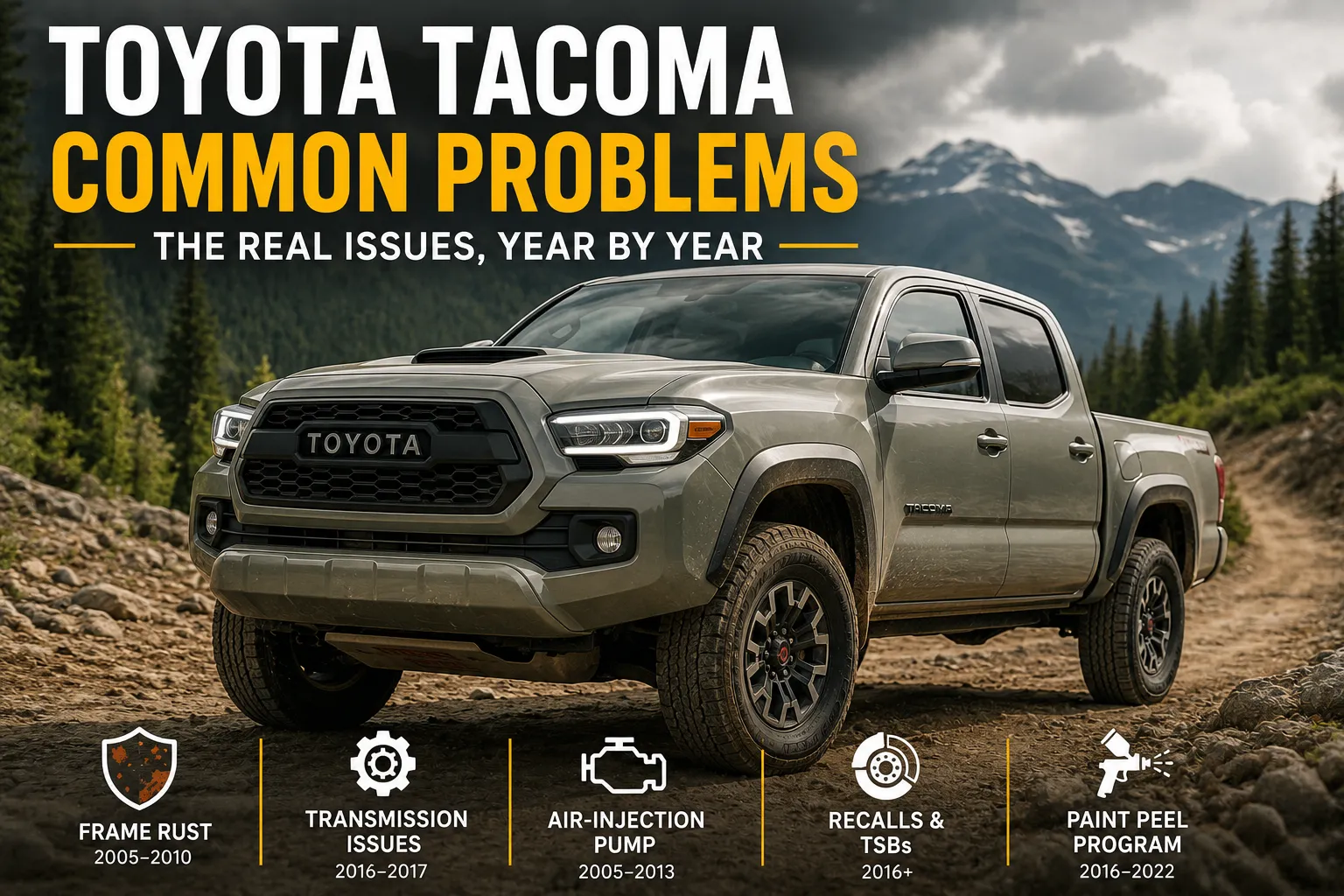
Nothing else on this page matters if the frame is gone. The 2005–2010 trucks are the documented core of the corrosion saga — frames that could rust to perforation, a problem serious enough that Toyota ran inspection and replacement programs and settled major litigation over it, with earlier trucks touched by related campaigns. Those remedies have expired by age, which converts the whole issue into one non-negotiable step: get the truck on a lift and put skeptical eyes (and a probing screwdriver) on the frame rails, crossmembers and mounts — decisive on anything that’s lived in a salt state, worthwhile on everything older than fifteen years. A replaced frame with paperwork is fine news, not a red flag. Perforation, flaking plate repairs, or a seller who won’t allow the inspection: walk.
The Tundra shares a version of this history, by the way — the playbook carries straight over to the Tundra’s year guide if you’re cross-shopping the big brother.
The 2016–2017 transmission: annoying, documented-adjacent, fixable
The third generation launched with a new 3.5-liter V6 and six-speed automatic, and the pairing spent its first two years hunting between fifth and sixth on the highway, shuddering, and hesitating off the line. Toyota’s answer came through recalibration service bulletins — not a recall — and by 2018 the complaints largely vanish from the record. That distinction matters both ways: nobody’s truck was recalled for this, and nobody should pretend the pattern wasn’t real. On any 2016–2017: hold highway speed on a grade and feel for the hunt, creep a parking lot for the hesitation-then-lurch, and have a dealer confirm the software status by VIN. A truck with the updates and a clean drive is a legitimate discount buy; the same truck without them is a negotiation.
Two smaller items share this era. Early 3.5L trucks can seep oil at the timing cover — look for weep down the front of the block; a proper reseal is labor money, so price it in. And the third brake light could let water into the cab on 2016-era trucks — a recalled item; check closure and look for headliner staining around the light.
- Frame: catastrophic but fully inspectable — and a documented replaced frame is good news, not stigma.
- 2016–2017 transmission: annoyance-tier with a published software fix; discounted trucks with updates done are value plays.
- 2024 items: documented, free to resolve, concentrated in early builds.
- Air-injection pump: $2,000–3,000+ surprise on an otherwise healthy truck — the classic unbudgeted hit.
- Timing-cover reseals are labor money; white-paint peeling outside program windows is a real cosmetic cost.
The air-injection pump: the four-figure cold-start gamble
Second-generation trucks (2005–2013, with 2012 the noisier year) carry the 4.0L era’s classic wallet-hit: the secondary air-injection pump, an emissions device that runs for a minute or two on cold starts. When it fails — and moisture makes it a when, not an if, in many climates — the truck can drop into limp mode, and the dealer repair runs $2,000–$3,000-plus out of warranty. It’s a reported pattern, never recalled, and the used-truck move is simple: listen at a stone-cold start for the pump’s whir (or grind), scan for the P0418-family codes, and treat a documented pump replacement or a quality bypass kit (where emissions rules allow) as money already spent on your behalf.
The 2024 items: new generation, familiar pattern
The all-new 2024 truck repeated the first-year script, and two items are on paper. A rear brake hose recall covers 100,000-plus 2024–2025 4WD trucks — hoses that can wear against components and eventually leak; free fix, VIN-specific. And the new 8-speed drew a transmission service bulletin for manufacturing debris that can stick the pressure-control solenoids, with a remedy that escalates as far as replacing the transmission and torque converter. Early-build 2024s are the concentration; later builds and 2025s settle down. Same rule as every Toyota redesign we’ve covered: VIN and TSB history first, then the price conversation.
Tacoma Problems at a Glance
| Car Name |
Spec Label
|
Spec Value
|
|---|---|---|
| 2005–2010 | Issue / Tier / Action | Frame corrosion / Documented (expired) / Lift inspection |
| 2005–2013 | Issue / Tier / Action | Air-injection pump / Reported / Cold-start listen + codes |
| 2016–2017 | Issue / Tier / Action | Trans hunting + timing cover + brake light / Reported (TSB) + recall / Test drive + VIN |
| 2016–2022 (white) | Issue / Tier / Action | Paint peeling / Documented CSP 23TE08 / Ask + verify |
| 2024–2025 | Issue / Tier / Action | Brake-hose recall + solenoid TSB / Documented / VIN + TSB history |
The paint program most sellers forget to mention
Certain 2016–2022 trucks in specific white colors qualify for a free factory repaint under Toyota’s Customer Support Program 23TE08 when the paint peels — one of the more generous programs running. If you’re looking at a white truck: peeling means leverage (or a free respray if the program window still applies to that VIN), and a completed repaint means fresh paint you didn’t pay for. Either way, ask.
The pre-purchase routine
- Lift inspection of the frame — decisive on 2005–2010 and any salt-state truck.
- VIN through Toyota/NHTSA: brake-hose recall (2024–2025), third-brake-light (2016), era campaigns on older trucks, 23TE08 status on white 2016–2022s.
- Highway + parking-lot transmission test on 2016–2017; TSB/software status by VIN. Solenoid-TSB history on early 2024s.
- Cold-start listen for the air pump on 2005–2013; scan for codes.
- Timing-cover weep check on 2016–2017; headliner check near the third brake light on 2016-era trucks.
- Records over odometer, every time.
And run the running costs honestly with our fuel cost calculator before you commit — mid-size trucks aren’t economy cars.
The bottom line
The Tacoma’s problem list is short, front-loaded at generation launches, and almost entirely verifiable on a lift or a VIN screen — which is exactly why the right-year trucks earn their reputation and their prices. Check the frame, verify the era-specific items, and the Tacoma keeps doing what built Toyota’s reliability reputation in the first place. The year-by-year verdicts — and which trucks to actually shortlist — are in the companion guide.