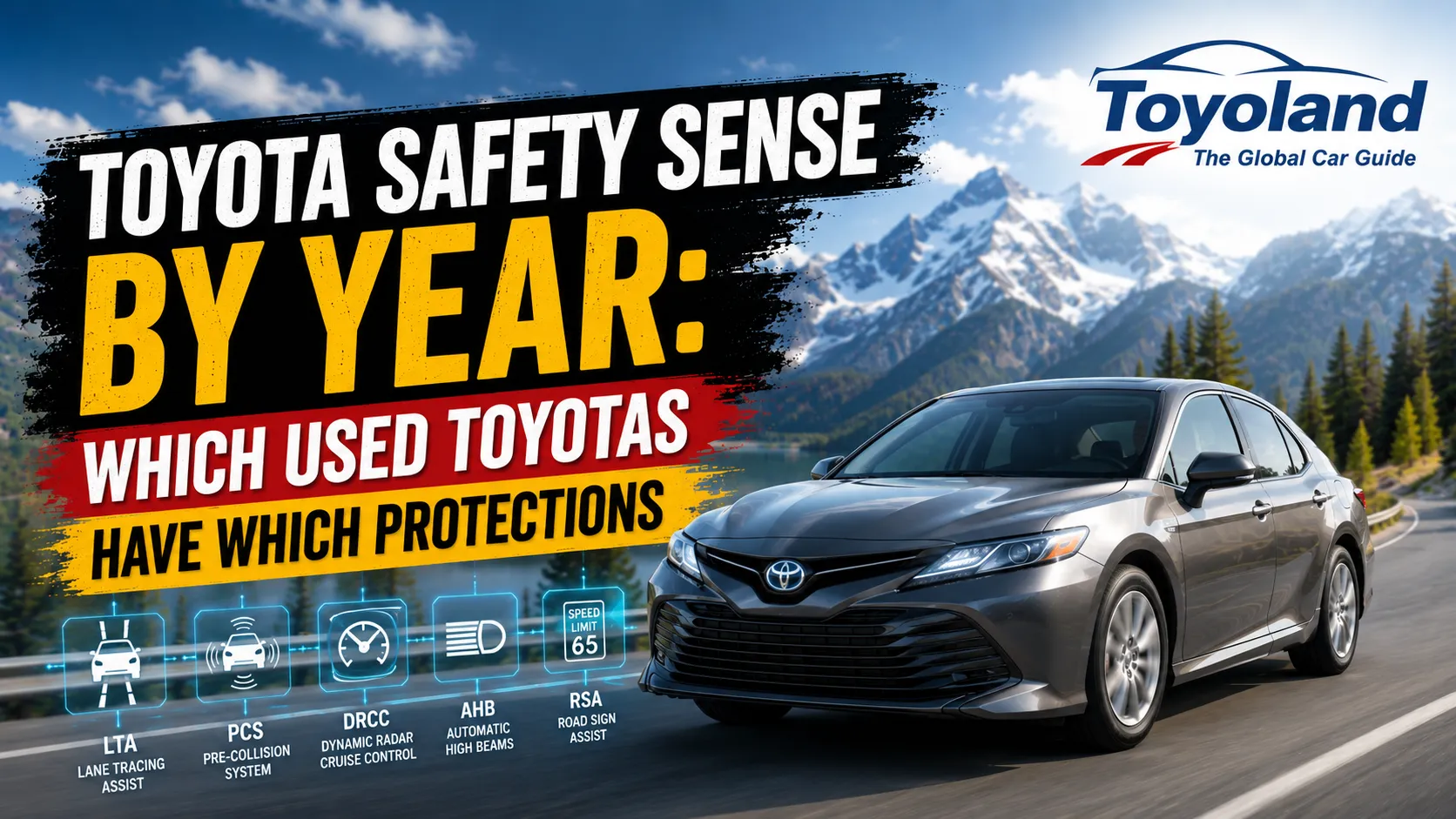

Two used Camrys sit side by side at similar prices, three model years apart — and one will brake for a pedestrian it sees at night, hold its lane on the highway, and manage stop-and-go traffic by itself, while the other will do none of that. Nothing on the window sticker makes this obvious. Toyota Safety Sense arrived in 2015 and has stepped up roughly every three years since, and for used buyers the safety generation is a spec that matters as much as the engine — sometimes more. Here’s the whole timeline, translated for the used market; it’s also Step 5 of our used Toyota buying guide.
The timeline in plain language
2015 — TSS-C and TSS-P arrive
Toyota started standardizing active safety when rivals still sold it as luxury-trim garnish. TSS-C (compacts) brought camera-based automatic braking, lane-departure warning and auto high beams; TSS-P (most other models) added radar — and with it the features people actually feel: pedestrian detection and Dynamic Radar Cruise Control. A TSS-P car is the earliest used Toyota we’d call properly protected.
2018 — TSS 2.0 changes daily driving
The second generation is the used market’s value inflection. Pre-collision learned to see pedestrians in low light and cyclists in daylight; lane-departure learned to read road edges, not just paint; and two features arrived that transform commuting — full-speed-range radar cruise (down to a stop and back, on automatics) and Lane Tracing Assist, which actively centers the car while cruise is engaged. A 2.0-era car does the tedious parts of traffic for you; a TSS-P car merely warns you.
2021 — TSS 2.5 and 2.5+ add the intersection layer
The upgraded camera and radar watch turns: oncoming traffic when you turn left, pedestrians crossing as you turn either way — plus Emergency Steering Assist to help steer around what braking alone can’t miss. Intersections are where an outsized share of real injuries happen, which makes this quieter upgrade more meaningful than its version number suggests.
2022–2023 onward — TSS 3.0 widens the eyes
A higher-resolution, wider-angle camera and improved radar bring motorcyclist detection, guardrail and varied-lane-marking recognition, and Proactive Driving Assist — gentle, automatic speed and steering support around curves, pedestrians and parked obstacles, working even without cruise engaged. Some 3.0 vehicles also take over-the-air updates, so the system improves after purchase. And on the newest launches, TSS 4.0 has begun appearing — for used shoppers today it’s a footnote; for everyone else it’s the direction of travel.
- Full-speed-range Dynamic Radar Cruise handles stop-and-go — the single most used ADAS feature in real commuting.
- Lane Tracing Assist actively centers rather than merely warning — fatigue reduction you feel every trip.
- PCS gains low-light pedestrian and daytime cyclist detection — protection matched to how urban crashes actually happen.
- Full-speed DRCC applies to automatics — manual-equipped examples differ; verify per car.
- 2.0's rollout tracked each model's redesign year, so the calendar line moves by model — the per-model note in the article is the map.
Which models got which version, when
Rollout was model-by-model, and early-year fitment sometimes varied by trim — so treat this as the shopping map and confirm the specific car (the vehicle’s spec sheet or a dealer VIN query settles it in a minute). The broad pattern for high-volume models: TSS-P became standard on most core sedans and crossovers across 2016–2018; TSS 2.0 arrived with each model’s redesign or refresh from 2018–2020 (Camry-family and RAV4-family among the earliest); the 2021 model year brought 2.5/2.5+ to the mid-size favorites (Camry, Highlander, Sienna, Venza); and 2022–2024 redesigns (Tundra, Sequoia, Prius, Tacoma, Land Cruiser) launched on 2.5 or 3.0 depending on the model, with most 2026 passenger models now standardizing 3.0. Trucks and body-on-frame SUVs typically ran a step behind the sedans — the 4Runner, famously, didn’t gain standard TSS-P until 2020, which is exactly the kind of quirk that makes the per-model check worth doing.
TSS Generations at a Glance
| Car Name |
Spec Label
|
Spec Value
|
|---|---|---|
| TSS-C (2015+) | Key adds / Shop note | Camera AEB, LDA, auto high beams / Safety floor — compacts |
| TSS-P (2015+) | Key adds / Shop note | Radar: pedestrian AEB, DRCC, steering-assist LDA / Earliest era to shop |
| TSS 2.0 (2018+) | Key adds / Shop note | Night pedestrian, full-speed DRCC, Lane Tracing, RSA / The value inflection |
| TSS 2.5 / 2.5+ (2021+) | Key adds / Shop note | Intersection support, Emergency Steering Assist / City-crash layer |
| TSS 3.0 (2022+) | Key adds / Shop note | Motorcyclist detection, Proactive Driving Assist, OTA / Newest used tier |
| TSS 4.0 (newest) | Key adds / Shop note | Latest sensors/software on new launches / New-car spec for now |
How to use this when shopping
- Identify the generation before you drive: model year + the model’s rollout note above, confirmed against the car’s spec sheet. Two minutes.
- New driver in the house? Make TSS 2.0 the floor — automatic braking that sees pedestrians at night plus lane centering is the cheapest guardian angel money buys.
- Long commute? Full-speed DRCC + Lane Tracing (2.0+) is the difference between arriving tired and arriving fine. Test it in traffic on the drive.
- City household? The 2021+ intersection support earns its keep at every left turn.
- Verify function, not just fitment: on the test drive, confirm the icons light, cruise locks on, and no ADAS warnings show — a TSS car with a fault or a mis-calibrated windshield camera isn’t delivering its spec.
For the youngest drivers especially, pair this with our first-car buying guide — safety generation plus the right model year is most of the battle won.
The bottom line
Toyota’s quiet achievement is that a modest used Corolla can carry a safety suite luxury brands charged thousands for — but only if you buy the right year of it. Learn the three lines that matter (2015, 2018, 2021), check the specific car, and let the safety generation break ties between otherwise-equal candidates. Family shoppers weighing sizes and rows can carry this straight into the best family SUVs and the model year guides — the protections above are standard equipment on every golden-year pick we recommend from 2018 onward.