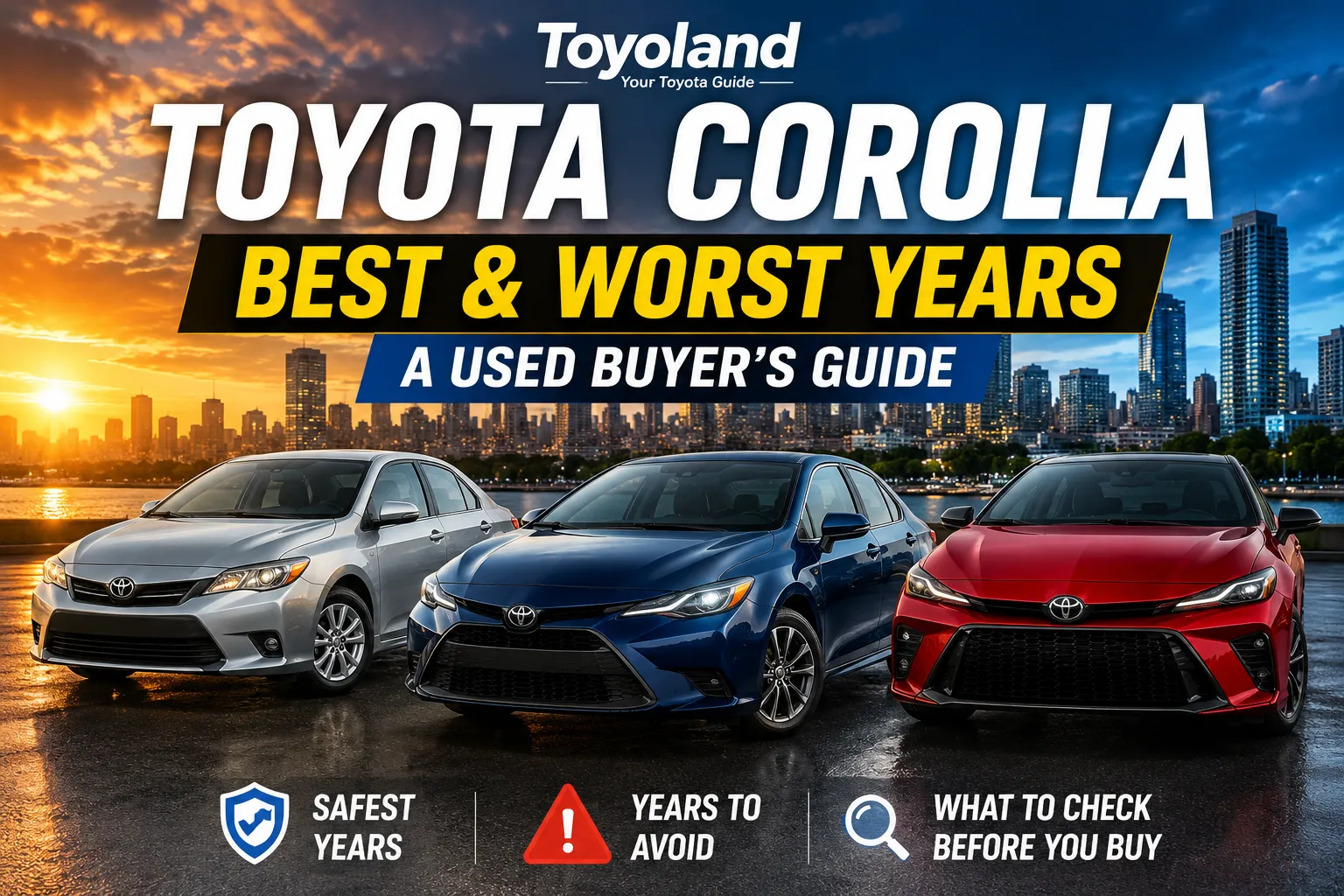

The Toyota Corolla is one of the best-selling cars ever built, and its reputation for lasting a long time is well earned. But “the Corolla is reliable” is a starting point, not a buying decision. Across the model years sitting on the used market today, most are genuinely dependable, a few carry specific quirks worth knowing about, and the internet’s “worst years” lists get some of the details wrong.
This guide is built to help one person: someone shopping for a used Corolla in 2026 who wants to know which years are the safest bets, which deserve a closer look, and why. Throughout, we separate what is documented (official recalls and Toyota programs) from what is reported (patterns in owner-complaint databases) from our own editorial assessment. That distinction is the whole point — it is how you tell a genuine defect from a repeated rumor.
The quick answer
If you want the short version before the detail:
- Best value: 2016–2018. Mature eleventh-generation cars with strong reliability, standard backup camera, and Toyota Safety Sense increasingly standard.
- Best modern pick: 2021–2022. Refined twelfth-generation cars with standard Apple CarPlay and Android Auto, a proven hybrid option, and top safety ratings.
- Approach with caution: 2009–2011 (a documented oil-consumption issue covered under Toyota’s now-closed ZE7 warranty program, plus reported steering patterns) and 2020 (a documented fuel-pump recall to verify) — cautions with reasons, not automatic disqualifications.
- Solid but situational: 2012–2015, 2019, and 2023–2025.
Notice there is no “avoid at all costs” year here. On the evidence, no Corolla model year earns a blanket condemnation. The weakest era is 2009–2011, and even those can be sound cars if the specific vehicle checks out.
Corolla generations at a glance
Reliability shifts with each redesign, so it helps to know which generation a given year belongs to. For the broader picture of how reliability varies across the Toyota lineup, the Corolla is a useful case study in steady, incremental improvement.
The generations that matter for today’s used market:
- Tenth generation (2009–2013): the era with the most reported early-life complaints (2009–2011), settling into solid form by 2012–2013. Traditional automatic or manual transmissions — no CVT yet.
- Eleventh generation (2014–2019): introduced the continuously variable transmission (CVT) for 2014, sharper styling, and — increasingly through the run — Toyota Safety Sense driver-assistance technology.
- Twelfth generation (2020–present): built on Toyota’s TNGA platform, this brought a proper Corolla Hybrid to North America, better handling, and modern infotainment. A mid-cycle refresh for 2023 replaced the 1.8-liter engine with a 169-horsepower 2.0-liter.
The best Corolla years to buy
2016–2018: the value sweet spot
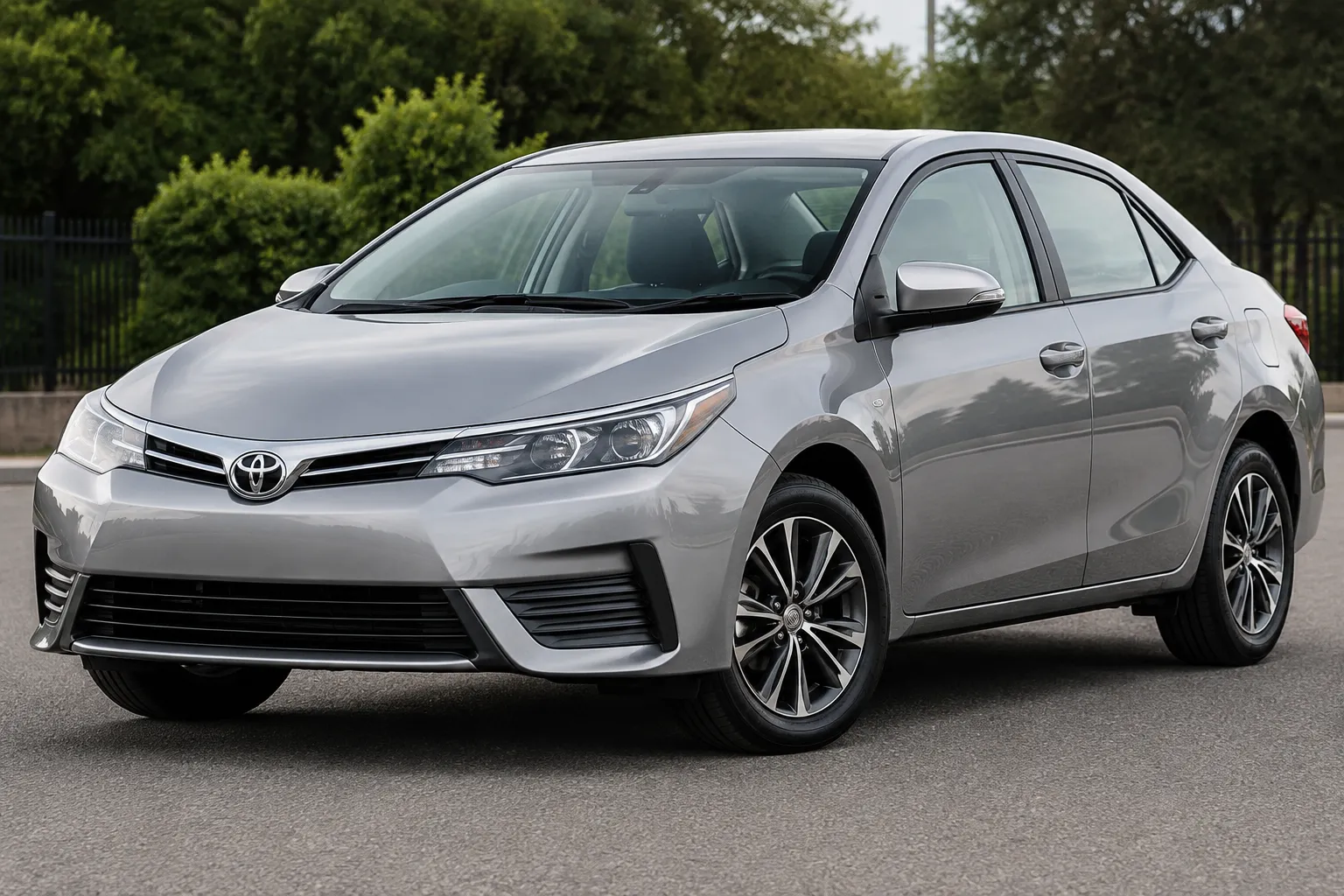
For buyers who want proven durability at the lowest price, the 2016–2018 Corolla is the standout. These are mature eleventh-generation cars, several years past the 2014 introduction of the CVT and the new platform, so the early-run items — first-year CVT calibration behavior and the earlier infotainment software — had been settled. Toyota Safety Sense (the TSS-P suite, with automatic emergency braking, lane-departure alert, and adaptive cruise) became standard on the Corolla around 2017, which is unusual and valuable at this price point; a backup camera was standard on most trims across this window and universal by 2018 under the federal rear-visibility rule. Reliability scores for these years are strong, and running costs are low.
Who it’s for: budget buyers, first-car shoppers, and anyone who wants Toyota dependability and modern safety tech without paying near-new prices.
 Toyota
2021–2022: the modern sweet spot
If you want current technology alongside the reliability, the 2021–2022 cars are the stronger choice. These are refined twelfth-generation Corollas on the newer TNGA platform, and from 2021 both Apple CarPlay and Android Auto are standard — a meaningful upgrade if connectivity matters to you. Predicted-reliability scores for these years are strong (independent assessments put the 2022 Corolla Hybrid around the mid-80s out of 100), and the Corolla sedan has a strong recent IIHS record: the 2022 sedan earned the top-tier Top Safety Pick+ award (for cars built after November 2021), and the 2023 sedan earned a Top Safety Pick.
The hybrid is a particular highlight. It uses a version of Toyota’s long-proven hybrid system, and it is genuinely efficient. If you are considering one, it is worth understanding
what to know about Toyota hybrid battery life before you buy, since that is the question most hybrid shoppers ask first.
The years that deserve caution
A year appearing here does not make it a bad car. It means there is a specific, verifiable reason to inspect more carefully or confirm a repair before buying.
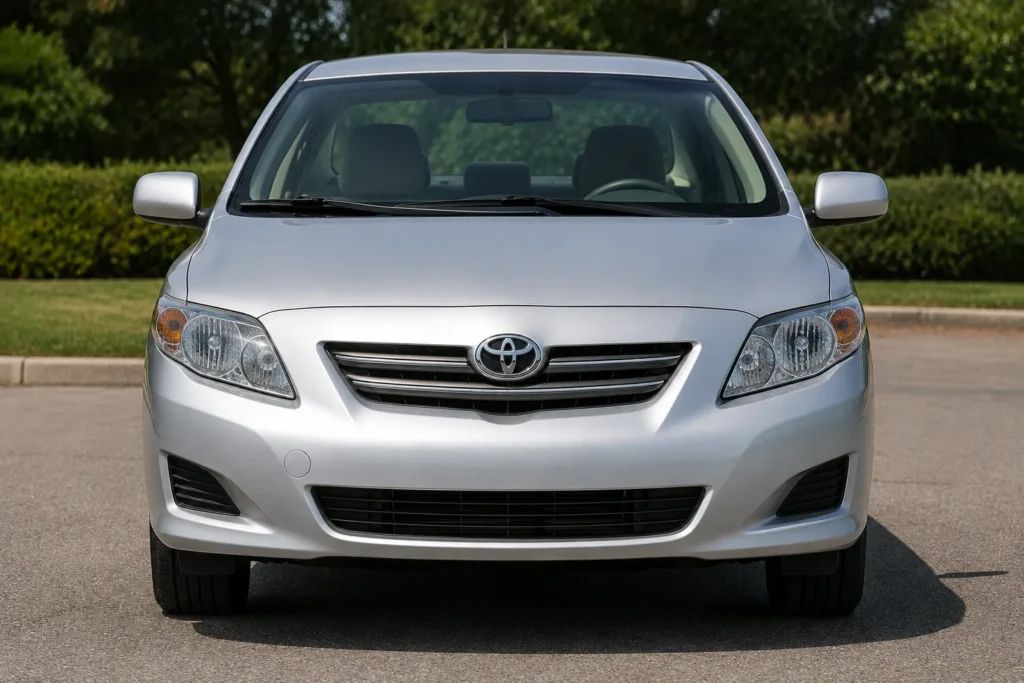
2009–2011: the oil-consumption era (documented) and reported steering
This is the weakest stretch in the modern Corolla’s record, and it is important to be precise about what the evidence actually shows — because most lists get it wrong in both directions.
Documented: the excessive-oil-consumption issue on the 1.8-liter (2ZR-FE) engine was covered by Toyota’s Warranty Enhancement Program ZE7 (Warranty Policy Bulletin POL14-12) — the same program that covered the equivalent Camry issue. For the Corolla, ZE7 named certain 2009–2011 Corolla vehicles (and certain 2009–2013 Corolla Matrix vehicles). The remedy was a dealer-performed oil-consumption test and, for cars that failed it, parts replacement up to and including a short-block, with extended coverage well beyond the standard warranty. This is a documented manufacturer program, not merely a rumor — but note it is a warranty enhancement, not a safety recall, and its coverage window has now closed. On a used car in 2026, that means excessive oil consumption is a buyer-beware item to verify rather than a free fix.
Reported: alongside the oil issue, these years drew heavy owner-complaint clusters for a wandering, vague electric power steering that made the car feel unstable at highway speeds. Documented nuance: that steering concern was investigated by NHTSA and addressed through a Toyota technical service bulletin that recalibrated the electric power steering — a TSB, not a recall.
To be clear that these cars were not recall-free: 2009–2010 Corollas were subject to separate, unrelated formal recalls, including a cold-climate brake-vacuum recall (NHTSA campaign 09V338000, affecting roughly 95,000 vehicles with the 1.8-liter engine in specified cold states) and, later, the industry-wide Takata-era airbag campaigns affecting the steering-column airbag spiral cable. Always verify all of these by VIN.
Editorial assessment: treat 2009–2011 as buy-with-care rather than never-buy. If you are looking at one, actively check oil-consumption history (the ZE7 coverage is closed, so any repair is now on you), confirm the steering recalibration bulletin was applied if the car wanders, and confirm all airbag and other recalls are closed. A well-documented example can still serve for years; an unknown one is a gamble.
- Fundamentally simple, durable mechanicals with no CVT to consider.
- Plentiful and inexpensive on the used market today.
- Later same-generation years (2012–2013) sit outside the oil-consumption coverage window and resolved most of the early complaints.
- Documented excessive-oil-consumption coverage under Toyota's ZE7 warranty enhancement (certain 2009–2011 Corolla; 2009–2013 Corolla Matrix); coverage window now closed, so verify engine oil history.
- Reported vague/wandering electric power steering; confirm the Toyota EPS recalibration bulletin was applied.
- Age plus airbag-related recalls (incl. Takata) mean VIN recall checks are essential.
2020: a documented recall to verify
The 2020 Corolla launched the twelfth generation, and like many first-year cars it draws slightly more scrutiny. Documented: the 2020 Corolla (including the Hybrid) is named in Toyota’s large multi-model low-pressure fuel-pump recall — a failing pump can cause the engine to stall, and the remedy is a free pump replacement. The 2020 Corolla Hybrid was also subject to recalls related to the rear seatbelt and vehicle stability control. All of these are per-VIN and free to fix.
Reported: beyond the recalls, first-year gripes were minor and mostly about packaging (a snug rear seat and smaller trunk opening). Notably, Consumer Reports still rated the 2020 Corolla as more reliable than the average car that year. Editorial assessment: this is a “verify the recalls are done” caution, not an “avoid.” A 2020 with completed recall work is a perfectly reasonable buy; a 2021 or 2022 simply sidesteps the first-year question for a modest premium.
Corolla Buying Snapshot by Era
| Era | Verdict | Why | Watch for |
| 2016–2018 (11th gen) | Best — value | Mature platform; TSS-P standard ~2017; backup camera standard on most trims | Age-related wear; confirm maintenance |
| 2021–2022 (12th gen) | Best — modern | Standard CarPlay/Android Auto; proven hybrid; Top Safety Pick | Higher price than older cars |
| 2009–2011 (10th gen) | Caution | Documented oil-consumption (ZE7 warranty program, now closed); reported steering | Oil history; EPS bulletin; brake-vacuum & airbag recalls |
| 2020 (12th gen, yr 1) | Caution | Documented fuel-pump recall (+ Hybrid seatbelt/VSC recalls) | Confirm all recalls completed |
Are Corolla CVTs reliable? Correcting the myth
Because the Corolla adopted a continuously variable transmission (CVT) for 2014, a lot of used-buying advice treats “CVT” as a red flag. The evidence does not support that alarm. The Corolla’s CVT is broadly reliable and is not a documented widespread failure point in the way some lists imply; there is no Corolla-specific CVT recall campaign comparable to the engine or fuel-pump items discussed above. The hybrid uses an electronically controlled CVT (eCVT) that is mechanically simpler still and has an excellent durability record.
That said, a CVT is not maintenance-free. The single most useful thing a buyer can do is confirm the car has been serviced with the correct Toyota CVT fluid (never a generic substitute) and that fluid changes were not neglected on higher-mileage examples. Treated properly, these transmissions routinely go the distance.
Common problems to check before you buy
Regardless of year, a short, targeted inspection protects you more than any online ranking. Prioritize these:
- Oil consumption (especially 2009–2011): check the dipstick, look for a low or dirty level, and ask how much oil the car uses between changes. Toyota’s ZE7 warranty coverage for this has closed, so records showing frequent top-ups are a genuine warning sign you’ll now pay to address.
- Recall completion (all years; critical for 2019–2020 fuel pump and any airbag campaigns): run the VIN through the NHTSA and Toyota recall lookups and confirm everything is closed.
- CVT fluid history (2014 onward): confirm correct Toyota CVT fluid and that changes weren’t skipped, especially above 60,000 miles.
- Steering feel (2009–2011): on a test drive, note whether the car tracks straight or wanders; confirm the EPS recalibration bulletin was applied if it does.
- Hybrid health (2020-onward hybrids): the high-voltage battery is a long-life component, but age and history still matter.Maintenance records overall: consistent servicing predicts how a specific Corolla will hold up far better than the model year alone.
Which Corolla is right for which buyer?
- Lowest budget, maximum reliability: a well-maintained 2016–2018.
- Modern tech and safety without new-car pricing: 2021–2022, gas or hybrid.
- Simplest, pre-CVT mechanicals: a clean 2011–2013.
- Cross-shopping the main rival: if you’re also weighing the Honda Civic, see how the Corolla compares with the Honda Civic.
- Considering a Toyota SUV instead: compare against how the RAV4 rates across its model years, or our Toyota Camry best and worst years guide for a midsize sedan.
Is an older “best year” better than a newer, less-proven one?
It is a fair question, because a pristine 2017 and a higher-mileage 2022 can sometimes cost similar money. The honest answer: condition and history usually matter more than the model-year label. A meticulously maintained 2016–2018 with full records can be a better buy than a neglected newer car — but a clean 2021–2022 gives you modern safety tech, better infotainment, and often remaining warranty. Decide based on the specific cars in front of you, not the year on paper. A “best year” with a bad history is still a bad buy; a “caution year” with documented repairs and clean records can be a bargain.
Final verdict
The Corolla earns its reputation, and the used-buying decision is mostly about matching a year to your priorities and then inspecting the individual car properly. For most people in 2026, the 2016–2018 range is the value champion and 2021–2022 is the modern-features pick. The years that call for genuine care — 2009–2011 for a documented oil-consumption issue (covered under Toyota’s now-closed ZE7 warranty program) and reported steering patterns, and 2020 for a documented recall to confirm — are cautions with reasons, not blanket disqualifications, and no Corolla year earns an outright “avoid.” Buy on condition, verify recalls and fluids, and understand what underpins Toyota’s dependability reputation — the Corolla is one of its clearest expressions.