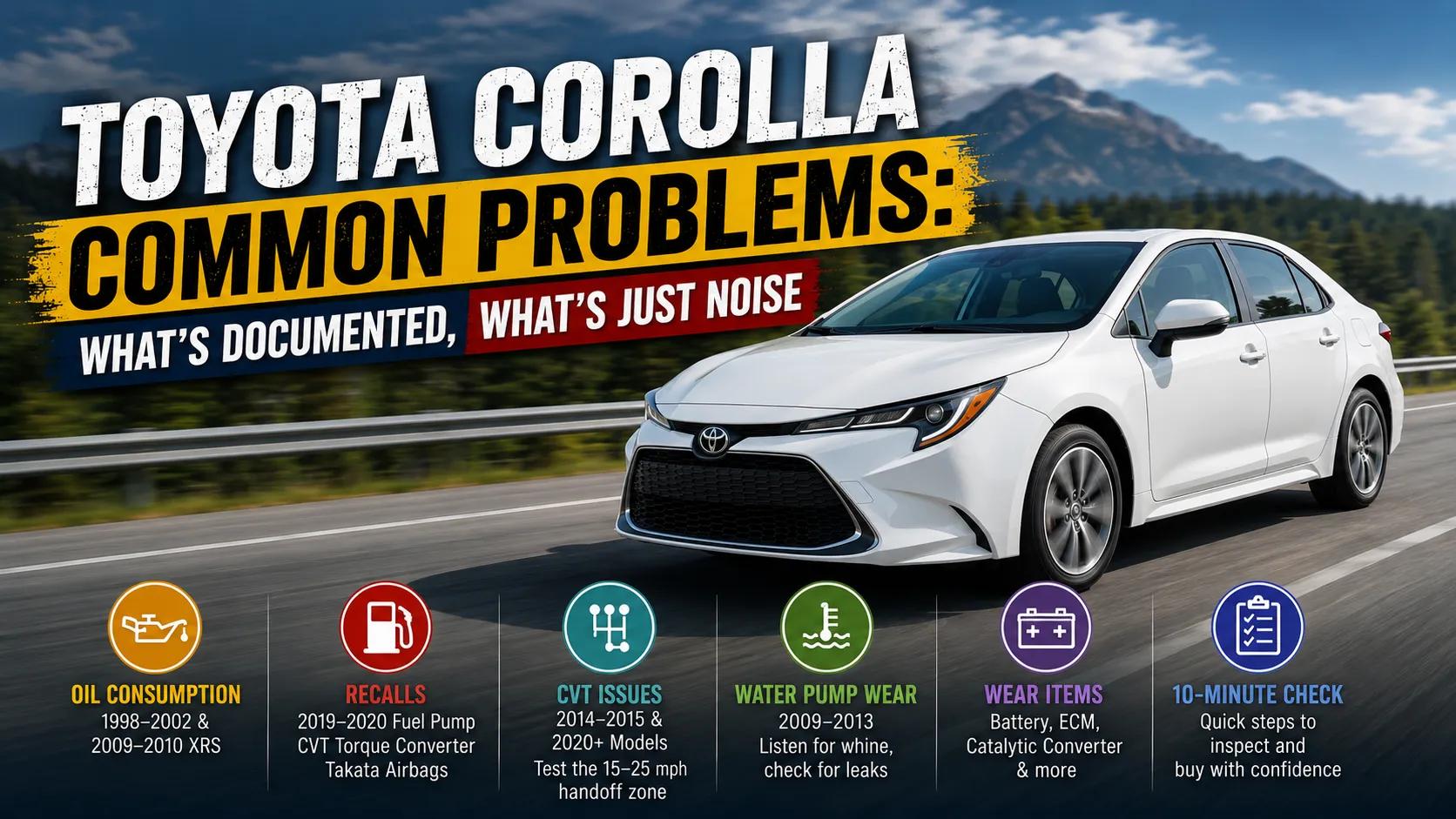

Fifty-million-plus Corollas have been built, which means two things: this is statistically one of the most dependable machines humans have ever made, and there are enough of them on the road for every weak point to be documented in exhausting detail. The trick is telling the real patterns from the noise — and knowing that the Corolla’s most famous problem is actually two different problems that the internet keeps mashing together.
Here’s the record sorted properly — Toyota’s own recalls and bulletins first, consistent owner reports second, and what to physically check on the car in front of you. For which years to shortlist, our Corolla best and worst years guide does the ranking; this page does the diagnosing.
The oil story — actually two stories
1998–2002 (1ZZ-FE 1.8L)
The early version of this engine burns oil, full stop. The piston-ring and oil-control design lets consumption creep up with miles, and if an owner never checks the dipstick, low oil quietly does what low oil does. Toyota revised the pistons mid-cycle and later cars improved, but there was never a U.S. coverage program for this one — it lives in owner reports and mechanic consensus. On any car from this window: dipstick first, ask how much oil it uses between changes, and treat a documented piston job as a selling point. A monitored 1ZZ will still run 300,000 miles; a neglected one won’t see half that.
2009–2010 (XRS trim only, 2AZ-FE 2.4L)
The sportier XRS borrowed the 2.4-liter from the Camry family — and inherited its documented oil-consumption problem. Toyota acknowledged it with a 2009 service bulletin, and qualifying engines fell under the same ZE7-family warranty coverage we’ve traced across the Camry and RAV4. That coverage has expired by age, so it’s a condition question now — but note the scope: the standard 1.8-liter cars of those years, which is nearly all of them, don’t carry this issue at all.
- 1998–2002 1ZZ: monitored cars still run 300k — consumption is manageable, not fatal, with attention.
- 2009–2010 XRS 2.4L: Toyota documented it (2009 TSB + ZE7-family coverage) — history is verifiable.
- The standard 1.8L cars of 2009–2010 — nearly the whole fleet — carry neither story.
- The 1ZZ issue never got a U.S. program; buyers rely entirely on condition and records.
- XRS coverage has expired by age — a burning example today is a negotiation, not a warranty claim.
The modern era’s recalls: three VIN checks
- Fuel pump (certain 2019–2020, with 2020 the core): the industry-wide Denso low-pressure pump saga — a failing pump can stall the engine. Same recall family we’ve documented on the Camry, RAV4 and Highlander; free replacement, VIN-specific.
- Direct Shift-CVT torque converter (certain 2019–2020 hatchbacks): a faulty converter could fail outright and cause loss of drive — recalled and remedied free. Sedans and hatches differ in scope, so run the specific VIN.
- The 2009–2010 acceleration-era campaigns and the Takata airbag recalls (which touch virtually every Corolla from roughly 2003–2013): ancient news, long remedied — but an open Takata inflator is the one thing on this page that should genuinely stop a purchase until it’s closed.
The CVT, honestly
Toyota’s CVTs have been among the more robust in the business, but two windows draw consistent complaints. Early 2014–2015 cars could feel jerky or hesitant until software updates settled them — a test drive plus a dealer software check answers it. The 2020-onward cars use the cleverer Direct Shift CVT, which launches on a physical first gear and hands off to the belt — and that handoff zone, roughly 15–25 mph, is where owners report shudder and hesitation. Toyota’s bulletins prescribe fluid changes and control-module recalibration; most cars improve, some owners say it lingers. Hold light throttle through that band on your test drive. Smooth is fine; shuddering means you negotiate the TSB work or keep shopping.
The wear items worth budgeting
Water pumps on 2009–2013 cars commonly give up between 100,000 and 130,000 miles — a grinding whine or coolant weep from the front of the engine is the warning, and $400–600 fixes it. It’s aging, not a defect. The 2003’s first-year gremlins (ECM complaints, transmission-bearing grind reports) are now just old-car diligence. Some owners of recent cars report 12-volt batteries dying young — worth a battery test at inspection. And one ownership reality that isn’t a defect at all: 2004–2009 Corollas became prime catalytic-converter theft targets, and a replacement runs $1,500–2,500 on a car that may not be worth much more — check what’s under there and whether a shield’s been fitted.
Corolla Problems at a Glance
| Car Name |
Spec Label
|
Spec Value
|
|---|---|---|
| 1998–2002 | Issue / Tier / Action | 1ZZ oil burning / Reported / Dipstick + top-up history |
| 2003 | Issue / Tier / Action | First-year ECM, trans-bearing reports / Reported / Records |
| 2009–2010 | Issue / Tier / Action | XRS 2AZ oil (TSB, ZE7) + acceleration-era recalls / Documented / Dipstick + VIN |
| 2009–2013 | Issue / Tier / Action | Water pump ~100–130k / Reported / Listen + look for weep |
| 2019–2020 | Issue / Tier / Action | Fuel-pump + CVT converter recalls / Documented / VIN closure |
| 2020–2024 | Issue / Tier / Action | CVT shudder 15–25 mph / Reported (TSB) / Light-throttle test |
The ten-minute check
- Dipstick and top-up history on any 1998–2002 — and on a 2009–2010 XRS specifically.
- VIN through Toyota and NHTSA lookups: fuel pump and CVT recalls on 2019–2020, Takata on anything 2003–2013, acceleration-era campaigns on 2009–2010.
- Light-throttle 15–25 mph test on 2020+ cars; general smoothness check on 2014–2015.
- Listen for water-pump whine on 2009–2013; look for coolant weep.
- Peek underneath on 2004–2009 cars — original cat, aftermarket cat, or shield?
- Records over everything, as always.
If this is a first car — and for half the people reading, it is — our first-car buying guide walks the whole inspection process.
The bottom line
Twenty-five years of Corollas produce a problem list you can check in a driveway: two oil eras (one documented, one reported), a handful of free-fix recalls, one transmission behavior to test for, and a water pump to listen for. That’s the shortest rap sheet in the class — which is precisely why the Corolla anchors reliability rankings across the Toyota lineup. Verify, test-drive, and buy the records.
And if you’re weighing the other default choice, our Civic vs Corolla comparison picks up from here.