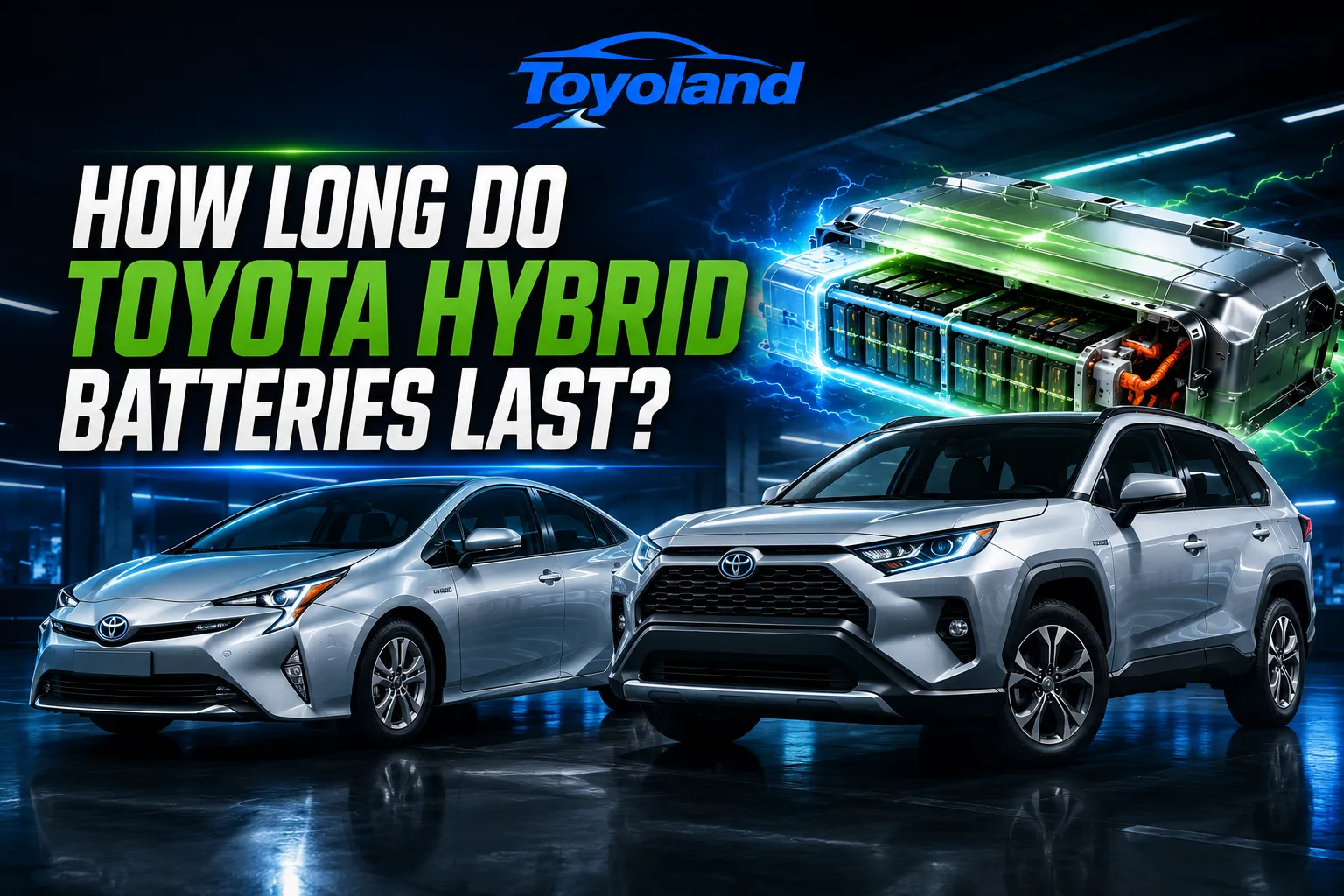

Whenever I recommend a Toyota hybrid to someone — and I do it often — I can predict the first question before they’ve finished nodding. It arrives in slightly different clothes each time, but it’s always the same worry underneath: “Yes, but what about the battery?” People imagine a ticking financial time bomb under the boot floor, a component that will fail at some unknowable date and cost more than the car is worth to replace. It’s the single biggest myth in modern car buying, and after years of tracking real-world hybrid ownership, watching taxi fleets rack up astronomical mileages, and talking to the mechanics who actually service these cars, I want to give you the honest, complete answer. Spoiler: the fear made sense in 2005. It doesn’t anymore.
The short answer
A Toyota hybrid battery routinely lasts 10 to 15 years and 150,000 to 200,000 miles, and a very large number go well beyond that — 250,000-mile examples on the original pack are common enough that hybrid taxi drivers barely mention it. Toyota backs the battery with a warranty of up to ten years or 150,000 miles in many markets (extended by annual hybrid health checks in some regions), which tells you something important: manufacturers don’t write warranties they expect to pay out on. The battery is not the weak point of a Toyota hybrid. In most cases, it outlasts components nobody worries about at all.
Why the fear exists — and why it’s outdated
The anxiety has a real origin. When the first hybrids appeared in the late 1990s and early 2000s, nobody — including, frankly, the engineers — could say with certainty how the batteries would age over two decades of real-world abuse. Early replacement quotes were genuinely alarming, and a handful of horror stories from that first generation calcified into permanent folk wisdom. The internet never forgets a scary invoice.
But here’s what the folk wisdom missed: those early batteries mostly didn’t fail either. The first-generation Prius became the accidental long-term experiment, and hundreds of thousands of them — including taxis living the hardest possible life, in stop-start city traffic, in extreme climates — quietly demolished the doomsday predictions. Toyota then spent twenty-five years refining the chemistry, the cooling, and above all the battery management software. A modern Toyota hybrid battery operates in a pampered middle zone of its charge range, never fully charged, never fully drained, actively cooled, and constantly balanced. It lives about the gentlest life any battery in any consumer product has ever lived. That’s the engineering reason the lifespan numbers are so strong.
What actually determines how long your battery lasts
Not all hybrid miles are equal, and understanding the variables helps you both buy smart and own smart.
Climate. Heat is the enemy of every battery chemistry. Hybrids in consistently very hot climates tend to sit at the shorter end of the lifespan range, while temperate-climate cars sail to the long end. If you’re buying used, a car that has lived its life somewhere mild has a quiet advantage.
Usage pattern. Counterintuitively, hybrids thrive on use. Regular driving keeps the pack cycling in its healthy zone. The cars that develop battery weakness disproportionately are the ones left sitting for months — long-term storage without occasional running is harder on the pack than a taxi’s daily grind.
Cooling system care. The battery has its own cooling arrangement, and in many models the intake vent sits inside the cabin where it can clog with dust and pet hair. A blocked vent means a hotter battery means a shorter life. Having the vent and fan cleaned at service time is a trivially cheap piece of preventative care that many owners have never heard of. Now you have.
Service history. As with everything in hybrid land, the boring answer wins: cars that visited a competent workshop on schedule, where battery health gets checked and software stays updated, age better. The health-check printout in a used car’s history folder is worth more than the seller’s reassurances.
The warning signs of an ageing battery
Hybrid batteries almost never fail like a light bulb — one day fine, next day dead. They fade, politely and gradually, and the car will usually tell you long before anything becomes urgent. Watch for these signals, particularly when test-driving a used example:
- Fuel economy drifting noticeably worse with no other explanation — the petrol engine compensating for a weakening pack.
- The engine running more often and more insistently than it used to, especially at low speeds where electric drive used to handle things.
- The battery gauge swinging rapidly between nearly full and nearly empty — a classic sign of reduced usable capacity.
- Warning lights, obviously — though by the time a hybrid system warning appears, the fade has usually been in progress for a while.
Any competent Toyota specialist can run a battery health report in minutes, cell block by cell block. If you’re buying used, paying for that check is the single best money you can spend in the process.
What replacement actually costs in 2026
Let’s confront the scary number directly, because it’s far less scary than folklore suggests, and — crucially — you have options that didn’t exist fifteen years ago.
New from Toyota: a brand-new pack, fitted by a dealer, is the premium route. Prices vary significantly by model and market, but the trend has been steadily downward in real terms for years, and the pack comes with its own fresh warranty. For a car you intend to keep another decade, it can be rational.
Refurbished packs: a healthy independent industry now rebuilds hybrid batteries by replacing only the weak cell modules within the pack. This costs a fraction of a new unit and, from a reputable rebuilder with a warranty, is a perfectly sound choice for an older car.
Individual module replacement: in many fade cases, only one or two modules of the dozens in a pack have actually weakened. A hybrid specialist can identify and swap just those, often for the price of a routine major service.
Here’s the framing that matters: amortise even a full replacement over the 150,000-plus miles a pack typically delivers, and the battery costs you less per mile than tyres. Meanwhile the hybrid has been saving you fuel every single one of those miles. The economics were settled a long time ago; only the reputation lags behind.
How to make your battery last as long as possible
- Drive the car regularly; if it must sit for months, arrange for it to be run periodically.
- Keep the battery cooling vent clean and ask for the cooling fan to be checked at services.
- Park in shade or garages in hot climates when you can — heat management is lifespan management.
- Keep up with scheduled servicing so software updates and health checks happen on time.
- If economy starts drifting, investigate early — catching one weak module beats replacing a neglected pack.
What’s actually inside: the battery, explained without jargon
A little understanding goes a long way toward killing the fear, so let me open the box. A Toyota hybrid battery isn’t one giant cell — it’s a pack of dozens of smaller modules wired together, sitting under or behind the rear seats, with its own dedicated cooling and a management computer whose entire job is protecting it. That modular construction is why the repair story is so much better than folklore suggests: when a pack “fails,” what has usually happened is that one or two modules out of the many have drifted weaker than their siblings. The computer notices the imbalance and raises a flag long before you’re stranded. A specialist can then test every module individually and replace only the weak ones — which is precisely why the independent refurbishment industry can offer repairs at a fraction of the price of a full new pack.
The management computer deserves particular credit for the longevity figures. Left to its own devices, any battery degrades fastest at the extremes — completely full and completely empty. So Toyota’s software simply never lets the pack visit those extremes, cycling it gently through a conservative middle band of its true capacity. Your phone battery, charged to 100% nightly and run to near-zero, lives a hard life and shows it within a few years. The hybrid pack, chaperoned every second by software tuned over two decades, lives the pampered opposite. Same fundamental chemistry challenge, utterly different outcome — by design.
NiMH vs lithium-ion: does the chemistry change the story?
You’ll notice spec sheets mention two battery types across Toyota’s hybrid range: the older nickel-metal hydride (NiMH) and the newer lithium-ion, with different models and trims using one or the other. Buyers sometimes worry there’s a right answer here. Relax: both chemistries have excellent field records in Toyota applications. NiMH is the veteran — heavier and less energy-dense, but astonishingly tolerant of abuse, extreme temperatures, and decades of cycling; it’s the chemistry inside most of those 300,000-mile taxi stories. Lithium-ion is lighter and packs more energy into less space, which helps economy and packaging, and Toyota’s conservative management has translated its consumer-electronics reputation for fragility into automotive-grade endurance.
For a used buyer, my practical advice is: don’t choose a car by its battery chemistry. Choose it by condition, history, and a health check — a well-treated example of either chemistry will outlast a neglected example of the other by years. The chemistry debate is interesting engineering trivia; the maintenance history is the actual predictor.
Should battery worries stop you buying a hybrid?
No — and I say that as someone whose job is to talk people out of bad purchases. The evidence from two and a half decades and millions of vehicles is unambiguous: the Toyota hybrid battery is a durable, warrantied, increasingly affordable-to-replace component with a longer proven track record than almost any comparable technology in the industry. The rational questions when buying a used hybrid are the same as any used car — history, condition, how it was treated — plus one cheap battery health check for peace of mind.
The irony I encounter constantly is that buyers agonise over the battery while ignoring the fact that the rest of a Toyota hybrid drivetrain — no conventional alternator or starter motor, no clutch, a famously simple transmission, brakes that last ages thanks to regenerative braking — has fewer wear items than the petrol car they’d buy instead. Viewed honestly, the hybrid isn’t the risky choice. It’s the safe one.