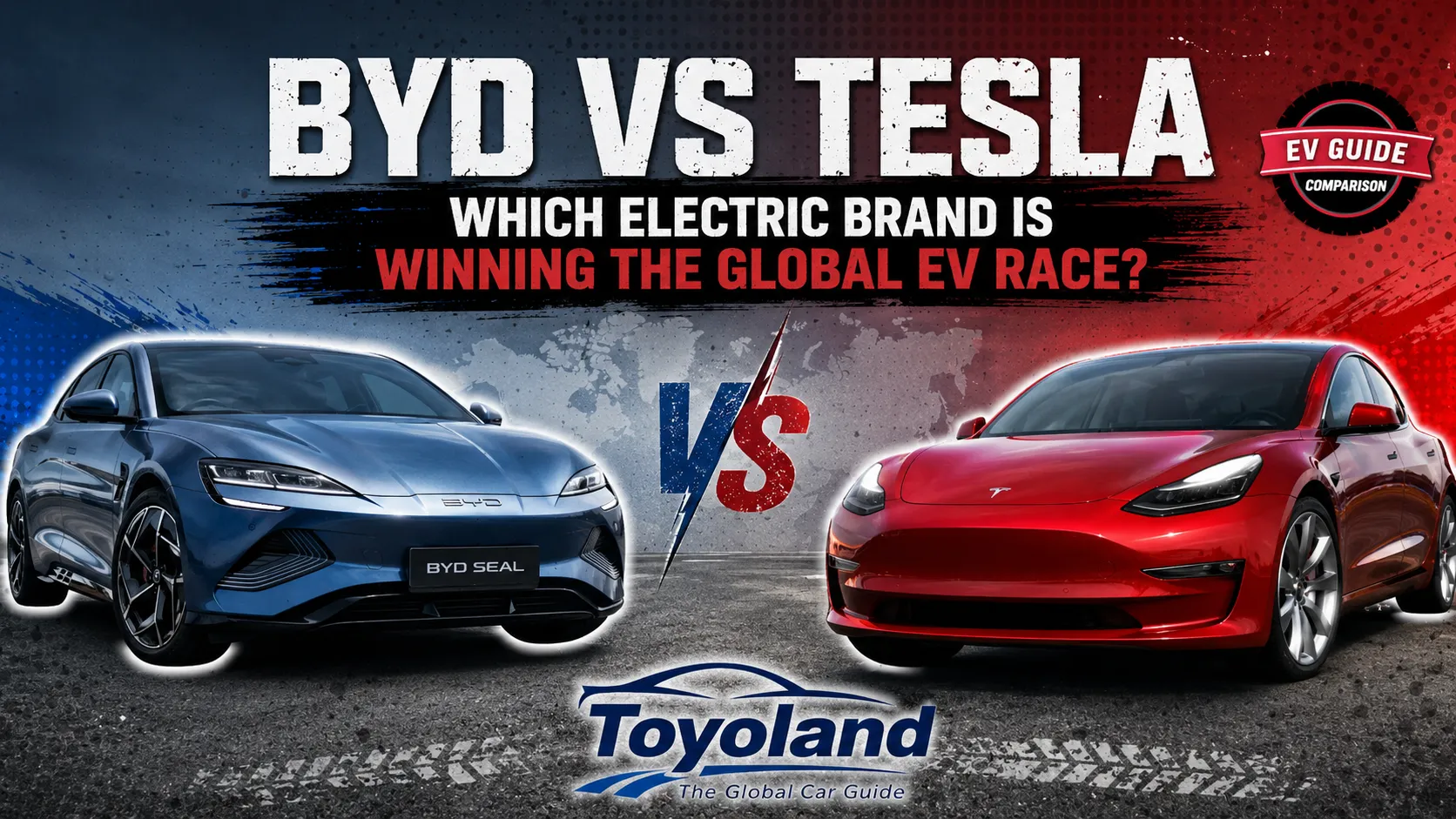

In 2023, BYD surpassed Tesla as the world’s largest seller of electric vehicles by volume. That fact generated significant press coverage, most of it either dismissing BYD as a temporary blip in Tesla’s dominance or dramatically overstating BYD’s global competitive threat. The reality is more nuanced and more interesting than either narrative suggests.
BYD and Tesla are genuinely different companies pursuing genuinely different strategies in the EV market. Understanding those differences — in technology, market positioning, product quality, and geographic strategy — is more useful than a simple declaration of a winner in a race that is playing out across multiple markets, price segments, and time horizons simultaneously.
The Companies: Very Different Origins
Tesla was founded in 2003 by Martin Eberhard and Marc Tarpenning, with Elon Musk joining as chairman and lead investor shortly after. It entered the market from the top down — starting with the high-price Roadster, moving to the premium Model S and X, and only reaching the mass market with the Model 3 in 2017. Tesla’s brand identity is built on technology leadership, software innovation, and a disruptive, premium-first positioning.
BYD — Build Your Dreams — was founded in 1995 as a battery manufacturer, not a car company. It entered the electric vehicle market leveraging its deep expertise in battery technology, which remains its core competitive advantage. BYD produces its own battery cells, its own electric motors, and its own semiconductors. The vertical integration that Tesla has pursued aggressively, BYD built over decades of battery manufacturing. It has approached the EV market from the mass market up, targeting volume and affordability before premium positioning.
Battery Technology: BYD’s Core Advantage
BYD’s Blade Battery technology, introduced in 2020, is one of the most significant battery innovations in the EV industry in recent years. The lithium iron phosphate (LFP) chemistry eliminates the cobalt used in the nickel-manganese-cobalt (NMC) cells that Tesla uses in most of its vehicles. LFP cells have lower energy density — meaning less range for a given battery size — but are significantly safer, more thermally stable, and cheaper to produce. They also degrade more slowly over time.
Tesla has responded to this by using LFP chemistry in some of its standard range vehicles, sourcing cells from CATL in China. BYD’s advantage is that it controls its own battery production entirely, which gives it a cost structure and supply chain security that most competitors — including Tesla in its non-proprietary cell sourcing — cannot match.
Product Quality: Tesla’s Reputation vs BYD’s Improvement
Tesla’s early production quality was famously inconsistent, with panel gap variations and interior finish issues generating significant owner complaints and media coverage in the Model 3’s early years. Tesla’s quality has improved with manufacturing refinements at Gigafactories in Texas, Germany, and Shanghai, but the brand still carries a quality perception challenge in European markets where material and build standards are benchmarked against German manufacturers.
BYD’s quality perception in Western markets is still developing. The Han EV, Atto 3, and Seal models that have entered European markets have received generally positive reviews for interior quality and feature content at their respective price points. The Seal in particular has been noted for offering a genuinely competitive driving experience alongside strong specification. The common criticism of BYD models in European reviews is that the infotainment systems and some interior details have a developmental quality — functional and improving, but not yet at the level of established European brands or Tesla at equivalent price points.
Geographic Strategy: Different Battles in Different Markets
Tesla is a global brand with strong positions in North America, Europe, and increasingly in China, where its Shanghai Gigafactory produces vehicles for both the Chinese market and for export. Tesla’s brand recognition and Supercharger network give it genuine advantages that newer market entrants cannot easily replicate.
BYD dominates in China, where it accounts for a substantial share of new EV sales. Its international expansion has been most aggressive in Southeast Asia, Australia, and Europe. In Europe, BYD has been notably impacted by the EU’s import tariffs on Chinese-made EVs introduced in 2024, which have significantly increased the cost of its vehicles in European markets and created a material competitive headwind.
Price and Value: Where BYD Has the Clearest Advantage
BYD’s most compelling argument in global markets is value for money. The Atto 3, priced from around £36,000 in the UK, offers a specification level that compares favourably with Tesla Model Y variants at significantly higher prices. The Seal’s performance figures are competitive with the Model 3 at a lower price point. For buyers whose priority is maximising EV technology per pound or dollar spent, BYD’s value proposition is genuine and should not be dismissed.
Which Brand Should You Consider
Choose Tesla if: you travel regularly and rely on fast charging infrastructure (Tesla’s Supercharger network remains the most extensive and reliable), you want the most refined over-the-air software update experience, or you value the brand’s technology-first positioning.
Consider BYD if: your daily driving needs are well within the range of a single charge, value for money is a priority, you live in a market where BYD’s pricing advantage has not been eroded by tariffs, and you are comfortable with a brand that is still building its service network in many Western markets.
The Verdict
In global EV volume terms, BYD is winning the race — that is simply what the sales data says. In premium brand value, technology perception, and Supercharger network infrastructure, Tesla is still ahead. These are not the same race. BYD is building the volume base and battery technology foundation to be a formidable global competitor over the next decade. Tesla is defending and extending the premium technology position it established. Both strategies are coherent. The EV market is large enough for both to succeed.