

Every year around this time, automotive industry analysts publish their global car market outlooks. They are usually careful, measured documents full of percentage changes and hedged predictions. I have been reading them for twenty years and writing my own version of this piece annually for most of that time. This year I want to do something slightly different and say some things that the press releases and analyst notes tend to leave out.
Because 2025 is a genuinely unusual moment in the car market. Several narratives that dominated automotive coverage for the past four years are colliding with a messier reality. And buyers who understand that reality will make better purchasing decisions than those who are still operating on 2022 assumptions.
The EV Slowdown Nobody Wanted to Admit
Let me just say it plainly: the EV adoption timeline that most manufacturers announced between 2020 and 2022 was wrong. Not slightly wrong — significantly wrong in multiple major markets. Ford, General Motors, Mercedes-Benz, and Volkswagen Group have all walked back aggressive EV commitment timelines in the past eighteen months. Ford took a $4.7 billion loss on its EV division in 2023. GM delayed its electric truck production targets. Mercedes quietly extended the life of combustion engine models it had previously announced for discontinuation.
This is not a collapse of the EV market. EVs are still growing. But the growth curve has proven shallower and more complicated than the boldest predictions suggested, particularly in the mainstream price segments where buyers are more sensitive to charging infrastructure gaps, purchase price premiums, and the practical realities of apartment living without home charging access.
The practical implication for buyers in 2025: the EV deals are improving. Manufacturers with inventory pressure are offering financing rates and cashback incentives that make EV economics more attractive than the sticker price suggests. If you were on the fence about EV ownership and your situation genuinely supports it, 2025 is a better time to buy than 2023 was.
The EV adoption timeline that most manufacturers announced between 2020 and 2022 was wrong. Not slightly wrong — significantly wrong.
Hybrids Won. Can We Just Acknowledge That?
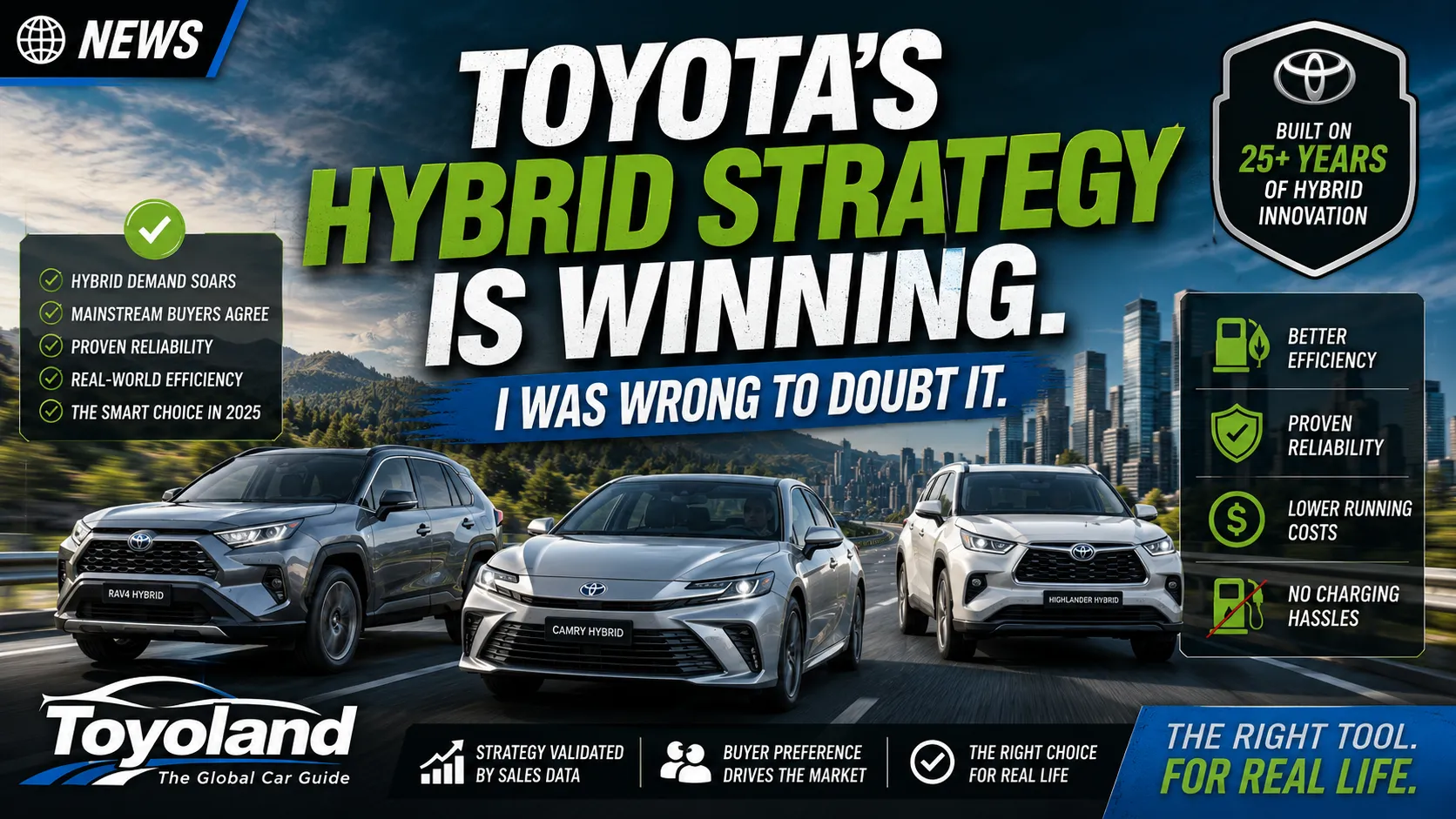
Toyota has been saying for years that the transition to full electrification would be longer and more complicated than a straight line from combustion to battery electric. The automotive press — and I include myself in this, because I was skeptical of Toyota’s conservatism in 2021 — generally treated this as a legacy automaker rationalising its slow EV development. It turns out Toyota was reading the market more accurately than most of its critics.
Hybrid vehicles are now one of the fastest-growing segments in multiple major markets. The RAV4 Hybrid is supply-constrained. The Camry is hybrid-only in North America and selling well. Ford’s hybrid F-150 has found a market that the full electric Lightning initially struggled to reach. Hyundai and Kia have accelerated hybrid development after seeing demand outpace projections.
I am not saying this to vindicate Toyota’s entire electrification strategy, which has moved slower on full EVs than it probably should have. I am saying it because buyers deserve to know that a hybrid vehicle in 2025 is not a compromise — it is a genuinely sensible choice that is well aligned with how most people actually use their cars.
Used Car Prices: The Correction Has Happened
In 2022, I watched a three-year-old Toyota RAV4 sell at auction for within 10% of its new car price. That was not normal. That was a supply chain crisis warping the used market into something genuinely strange. It has now largely corrected.
Used car prices in most segments are down 15–25% from their 2022 peaks. They are still above pre-pandemic levels — the frantic buying of 2020–2021 pulled a lot of demand forward and the inventory hasn’t fully caught up — but the market is functioning more normally again. For buyers who stepped back from the used market in 2022 and 2023 because the prices were irrational, it is worth looking again.
The one caveat: used EVs are a complicated story right now. First-generation used EVs from 2019–2021 are sitting on dealer forecourts with significant pricing uncertainty because nobody is quite sure how to value battery degradation at scale in the used market. If you are buying a used EV, get the battery health checked by an independent specialist before committing.
Financing: The Cost Nobody Was Talking About in 2021
When interest rates were near zero, financing a car was almost free. A $40,000 vehicle financed at 2% over five years has a meaningfully different monthly payment than the same vehicle financed at 7% over five years. This arithmetic destroyed new car affordability for a significant portion of the buying population between 2022 and 2024, and it explains more of the EV adoption slowdown than most industry commentary acknowledges.
Rates have moderated somewhat from their peaks but remain significantly above the zero-rate environment that shaped automotive buying patterns for the preceding decade. The manufacturers who are winning market share in this environment are the ones offering subsidised finance rates on specific models — below-market loans funded by the manufacturer rather than a bank. These deals exist and are worth finding before you accept whatever rate a dealer quotes you on day one.
What To Do With All of This
Buy a hybrid if your situation does not clearly support EV ownership. The technology is mature, the running costs are meaningfully lower than a petrol equivalent, and the hassle level is zero. Compare finance offers aggressively — the rate you are first quoted is rarely the best available. And if you are in the used market, 2025 conditions are considerably more rational than anything we saw in 2022 or 2023.
The car market in 2025 is not simple, but it is navigable. The buyers who will do worst are those operating on assumptions formed during either the pandemic supply chaos or the zero-interest-rate era. Both of those worlds are gone.