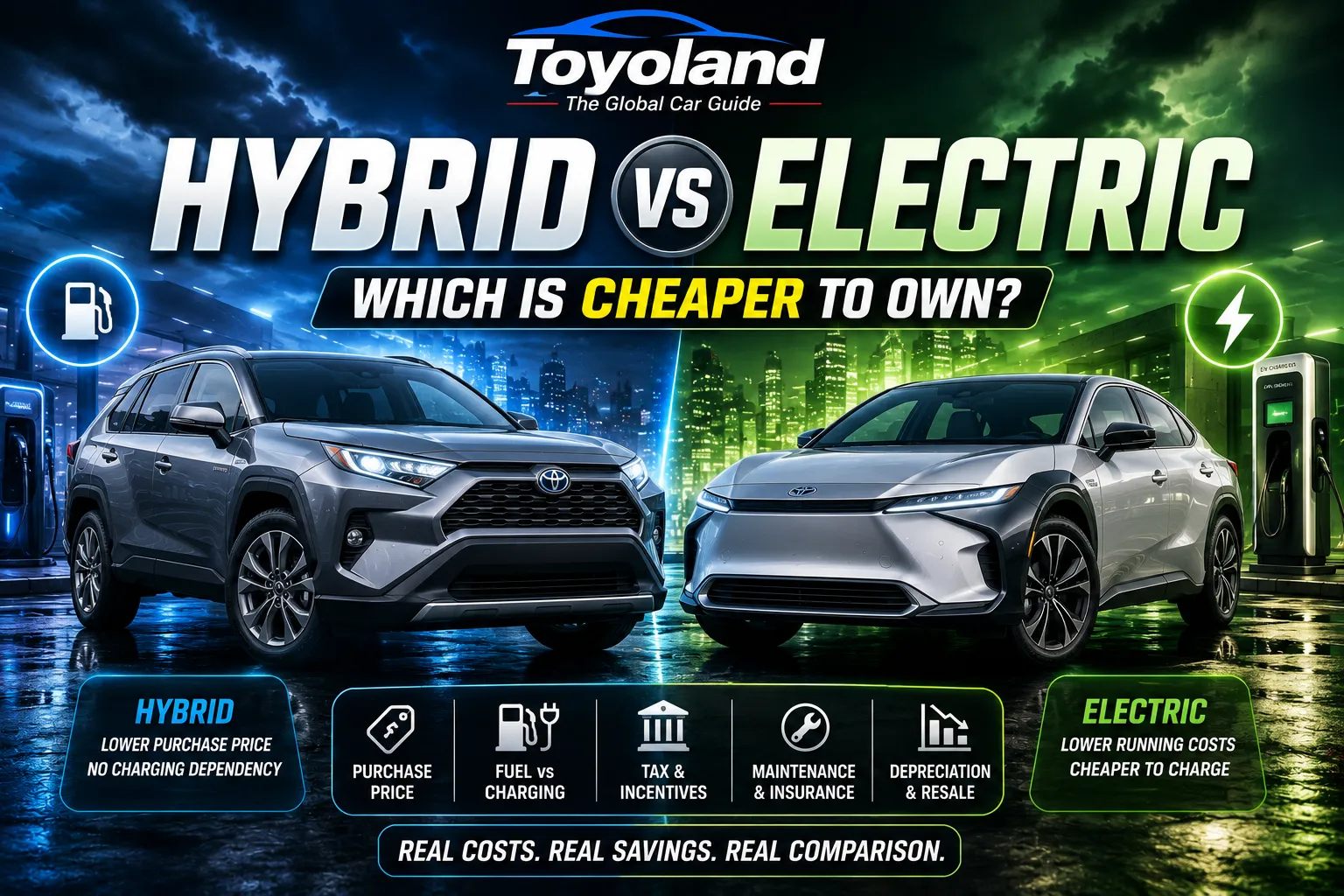

There is more noise around the hybrid-versus-electric question than almost any other topic in motoring right now, and nearly all of it argues about the wrong things. Enthusiasts debate battery chemistry. Commentators debate the future of the industry. Meanwhile, the people actually standing in showrooms with their savings on the line are asking a much simpler question, the one they ask me at barbecues and in comment sections alike: which one will cost me less to live with? That’s the right question, and it deserves a proper answer — not a slogan from either camp. So let’s do what I’d do with you at my kitchen table: work through every cost of ownership, one by one, honestly, and figure out where the real break-even points sit in 2026.
The five costs that decide everything
Total cost of ownership comes down to five buckets: what you pay to buy the car, what you pay to move it, what you pay the government, what you pay to maintain and insure it, and — the one everyone forgets — what you lose when you sell it. A car that wins three buckets can still lose the war in the other two, which is exactly why headline claims from both camps mislead people. Let’s take them in order.
1. Purchase price: the hybrid’s head start
Electric cars have become dramatically cheaper than they were even three years ago, with intense competition — particularly from newer entrants — compressing prices across the market. But like-for-like, a comparable hybrid still typically undercuts its electric equivalent at the point of sale. That gap is the hybrid’s head start, and everything that follows is essentially a race: can the EV’s lower running costs claw back the difference before you sell the car?
Two wrinkles complicate the sticker comparison. First, incentives: various markets still offer purchase grants, tax credits, or registration discounts for EVs that can shrink or erase the gap — check what applies where you live, because it changes the maths materially. Second, the used market: secondhand EVs have become genuine bargains as early depreciation bites, which flips this entire section on its head for used buyers. More on that in the depreciation section, because it cuts both ways.
2. Fuel versus charging: where EVs earn their keep
Here is the electric car’s strongest suit, with one enormous asterisk. If you can charge at home — especially on an off-peak overnight tariff — the cost per mile of an EV is dramatically lower than even an efficient hybrid’s petrol. Over a typical year of average mileage, home charging can save a serious sum against pump prices, and over five years those savings compound into real money. This is the engine of the entire EV value case.
The asterisk: public rapid charging is a different economy altogether. Rapid charger pricing in many places now rivals or exceeds the per-mile cost of petrol in a frugal hybrid. A driver who relies mostly on public rapid charging can end up saving little or nothing on fuel — sometimes paying more. So the honest question isn’t “is charging cheaper than petrol?” It’s “what does charging cost for the way I will actually charge?” No driveway or home charger? Be brutally honest with yourself about this before the showroom, not after.
The hybrid’s counter-argument is consistency. It asks nothing of your housing situation, sips fuel at a rate that would have seemed miraculous a decade ago, and refuels anywhere in five minutes. It never wins the cost-per-mile contest against home charging, but it never loses badly to anything, anywhere. Before deciding, run your own annual mileage through a fuel cost calculator with local prices — the break-even point is personal, and ten minutes of arithmetic beats any pundit’s generalisation, including mine.
3. Tax and official charges
Governments have historically tilted the table toward electric cars with lower road tax, exemptions from city charges, and company-car tax advantages that in some markets are decisive. That tilt is slowly levelling as EVs become mainstream and treasuries notice the missing fuel-duty revenue — several jurisdictions have begun taxing EVs where they once exempted them. The direction of travel matters if you’re keeping the car for years: buy an EV for a tax break, and you’re betting the break outlives your ownership. Check your local rules, and use a road tax calculator rather than assuming last year’s rates still apply. For company-car drivers specifically, EV tax treatment remains one of the strongest financial arguments in the whole debate in many markets — if that’s you, do this sum first.
4. Servicing, repairs and insurance
On paper, the EV wins servicing easily: no oil changes, no exhaust, no clutch, vastly fewer moving parts, and brakes that last remarkably long thanks to regenerative braking. Routine maintenance on an electric car is genuinely minimal, and over several years the savings are real.
The picture has nuance, though. EV repairs, when they do happen, can be costlier — specialist labour, expensive components, and in some unfortunate accident cases, battery-pack considerations that can write off an otherwise repairable car. That risk profile feeds directly into insurance, where EVs have tended to cost more to cover than equivalent hybrids, though the gap varies enormously by model and is narrowing as insurers accumulate data. Toyota-style hybrids, for their part, are about as cheap to keep as combustion cars get: the hybrid components themselves are famously long-lived, regenerative braking spares the brakes here too, and any competent garage can handle the routine work. Get insurance quotes for the specifi
c models on your shortlist before you decide — the spread between two similar cars can be surprisingly wide, and an insurance estimator makes this a five-minute job.
5. Depreciation: the silent decider
Now the bucket that outweighs the others for most private buyers, and the one nobody puts in their adverts. Depreciation — the gap between what you pay and what you get back — is usually the single largest cost of owning any car. And it’s here that the last few years have been genuinely turbulent for electric cars. Rapid price cuts on new EVs, fast-improving technology making older models feel dated, and uncertainty among used buyers have combined to give many EVs steeper early depreciation than their hybrid counterparts. Established hybrids from trusted brands, by contrast, have been resale-value fortresses — the used market knows exactly what it’s getting and pays accordingly.
This cuts two ways, and here’s the insight that reframes the whole debate: steep depreciation is a catastrophe for the first owner and a gift to the second. Buying a lightly used EV at two or three years old, after someone else has absorbed that first brutal drop, may be the single best value play in the current car market — you get the cheap running costs without paying the new-car premium that made them necessary. If your priority is pure pounds-per-mile, a used EV with home charging is arguably the answer to this entire article. If you buy new and trade often, the hybrid’s gentler depreciation curve quietly protects you.
A worked example: how the five-year sum actually plays out
Abstract principles are easy to nod along to, so let me show you the shape of the arithmetic with a realistic sketch — your local prices will differ, but the structure won’t. Imagine two comparable family crossovers, one hybrid and one electric, with the EV costing somewhat more to buy. Driver A does average annual mileage and charges at home overnight on a cheap tariff. Their per-mile energy cost is a small fraction of the hybrid’s petrol cost, so every year the EV claws back a meaningful chunk of its purchase premium; add lower servicing, and somewhere in the middle years of ownership the lines cross — from that point on, the EV is simply the cheaper car, and the longer they keep it, the wider the win grows.
Now rerun the same sum for Driver B: identical car, identical mileage, but no driveway, so four-fifths of their charging happens on public rapid chargers at several times the home rate. Their per-mile saving versus the hybrid shrinks toward zero — some months it inverts. The purchase premium never gets clawed back, and when they sell, recent EV depreciation patterns may take another bite. Same cars, same roads, opposite verdicts. That’s the entire article in one pair of drivers, and it’s why I keep refusing to give a one-line answer: the deciding variable isn’t in the car, it’s in your parking arrangements. Sketch your own version of this sum with a fuel cost calculator and your honest charging reality before any showroom visit — it’s ten minutes that can save you thousands.
The third option: where plug-in hybrids fit
No honest version of this comparison can ignore the car sitting between the two camps. The plug-in hybrid (PHEV) offers a battery big enough for typical daily errands on electric power alone, with a petrol engine waiting behind it for longer trips. For one specific driver, it’s brilliant: someone with home charging whose daily mileage fits inside the electric range, but who regularly makes long journeys where charging would be a chore. That driver commutes electrically all week and drives to the coast on petrol at the weekend — genuinely the best of both.
The catch is that the PHEV’s economics collapse if you don’t plug it in. Unplugged, you’re carrying a heavy battery around purely as ballast, and real-world economy can fall below a conventional hybrid’s. The data on real-world PHEV use suggests a surprising number of owners rarely charge them — usually company-car drivers who chose the badge for tax reasons. So the PHEV earns a conditional recommendation: superb if your life fits its pattern and you’ll actually plug in daily; an expensive compromise if you won’t. Be honest about which owner you’d be.
The verdict: three profiles, three answers
The electric car wins if: you can charge at home, cover average-or-better annual mileage, and either buy used or keep the car long enough for running-cost savings to overtake the purchase premium. For this profile, the EV is clearly and increasingly the cheaper car to own.
The hybrid wins if: you can’t charge at home, your mileage is modest, you make frequent long unplanned trips, or you buy new and change cars every few years. The hybrid’s lower entry price, fortress resale values, and refuel-anywhere flexibility make it the lower-risk, often lower-cost choice for this life.
It’s a genuine tie if: you’re between those profiles — in which case decide on the practical stuff: your parking situation, your patience for charging, and which car you simply prefer sitting in. When the money is close, comfort should break the tie. You’ll be living with the thing for years.
The dishonest answer is any universal one. The honest answer is that the winner lives in your driveway, your commute, and your electricity tariff — and now you know exactly which numbers to run to find it.