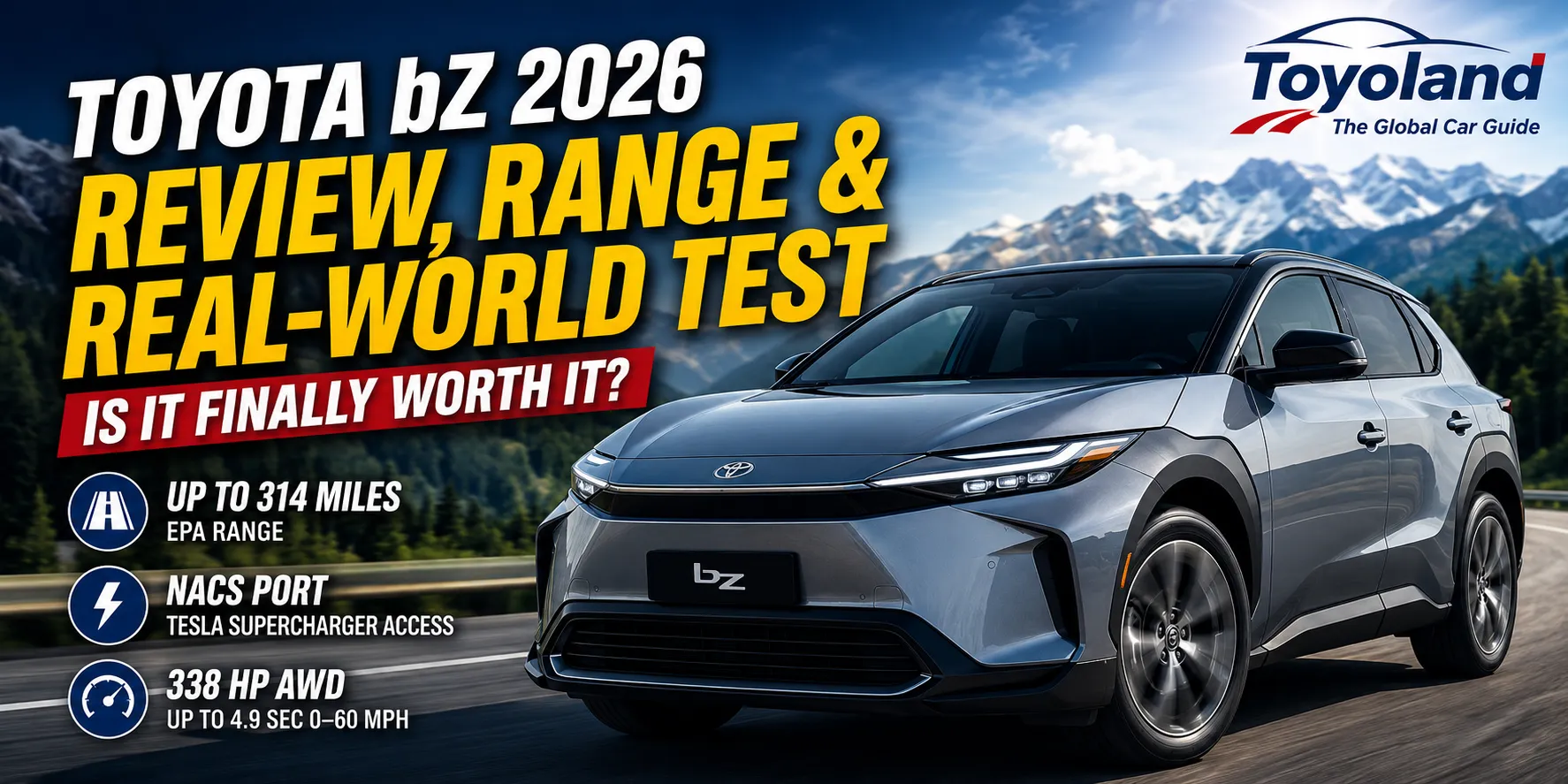

Toyota entered the U.S. mainstream EV market cautiously, launching the bZ4X in 2023 to a lukewarm reception: modest range, slow fast-charging, and a name nobody could remember. For 2026 the company has answered most of those complaints and, in the process, given the car a cleaner name. The Toyota bZ4X is now simply the Toyota bZ, and it is a genuinely different proposition: more range, far more power in all-wheel-drive form, and — the change that matters most day to day — a native NACS port that plugs straight into Tesla’s Supercharger network.
This review is written for one person: someone deciding in 2026 whether Toyota’s electric SUV is worth buying, how it actually lives with a daily commute, and whether it makes more sense than one of Toyota’s excellent hybrids. Throughout, we separate what Toyota and the testing agencies document from what owners and independent testers report, and we flag where our own editorial judgment takes over. We do not manufacture a single “winner” — the honest answer depends on how and where you drive.
The quick verdict
If you want the short version: the 2026 bZ is a much better car than the bZ4X it replaces, and for the first time it is easy to recommend to the right buyer. It is comfortable, well-equipped, backed by Toyota’s engineering conservatism, and — thanks to NACS — finally convenient to charge on a road trip. Its up-to-314-mile range figure is competitive, and independent testing suggests it can beat that in gentle use.
But it is not the range or charging-speed champion of its class, its all-wheel-drive versions trade meaningful range for their extra power, and — importantly — the 2026 bZ is not an IIHS Top Safety Pick. Its crashworthiness is respectable rather than class-leading: Good in the side test but only Acceptable in both updated frontal tests, and its standard headlights are rated Poor — a combination that keeps it off the award list. For a Toyota, that safety picture is worth knowing up front. Our take: a strong buy for a one-EV household with home or reliable public charging who values comfort and Supercharger access over outright range; a tougher call for high-mileage road-trippers, and often the wrong call for someone who would be just as happy — and hassle-free — in a Toyota hybrid.
What exactly is the Toyota bZ (and what was the bZ4X)?
The bZ is Toyota’s compact, five-seat electric SUV — roughly RAV4-sized — and its most established mainstream EV in the U.S. as Toyota’s electric lineup expands (the smaller C-HR is joining as a second EV). It was launched for 2023 as the bZ4X (the name gestured at Toyota’s “beyond zero” EV sub-brand), engineered on the e-TNGA platform and developed jointly with Subaru, whose near-identical version is the Solterra. If you are new to electric cars generally, our complete guide to EVs is a good place to start before diving into the specifics below.
The crucial thing for a 2026 shopper is to not confuse the two eras. The 2023–2025 bZ4X is the original car: smaller batteries, up to 252 miles of range, slower charging, and a CCS charge port. The 2026 bZ is a heavily updated car with a new name, bigger available battery, more power, faster and more convenient charging, and a restyled interior. When you read older reviews complaining about the bZ4X, remember that many of those criticisms were specifically addressed for 2026.
Toyota’s 2026 overhaul (announced May 2025) is a real mid-cycle redesign, not a trim shuffle. The headline changes, per Toyota:
- New name: bZ4X becomes simply bZ.
- More range: up to a manufacturer-estimated 314 miles (XLE FWD with the larger battery), a roughly 25% jump from the old 252-mile peak.
- A bigger battery option: a new 74.7-kWh pack on most trims, with a smaller 57.7-kWh pack on the base XLE FWD.
- More power: all-wheel-drive models rise about 50% to a combined 338 horsepower (0–60 mph in about 4.9 seconds); front-drive models rise to 221 horsepower.
- NACS charging: a native North American Charging System port for direct Tesla Supercharger access, plus Plug & Charge, an upgraded 11-kW onboard AC charger, and battery preconditioning to improve cold-weather fast-charging.
- Restyled inside and out: a new front fascia and a larger standard 14-inch touchscreen.
Toyota also added a rugged, off-road-styled Woodland variant at the top of the range: standard all-wheel drive, higher output, added ground clearance and roof rails, and its own EPA range figure (around 260 miles). We treat it separately from the mainstream XLE/Limited trims below because it is a distinct, more specialized proposition rather than just another trim level. The net effect of the 2026 overhaul is that the two weakest parts of the original car — range and charging convenience — are the two things most improved.
- Much-improved range — up to a manufacturer-estimated 314 miles (XLE FWD, larger battery), ~25% more than the old bZ4X.
- Native NACS port for direct Tesla Supercharger access, plus Plug & Charge and battery preconditioning.
- Substantially more power — up to 338 hp (AWD, ~50% increase), 0–60 mph in about 4.9 seconds.
- Lower starting price than the outgoing model, plus an 8-year/100,000-mile battery warranty (capacity below 70%).
- Not an IIHS Top Safety Pick for 2026: Acceptable (not Good) in both frontal crash tests and Poor-rated headlights, though it earns Good in side impact and both crash-prevention tests.
- Peak DC charging (~150 kW) is competitive but not class-leading, and the platform's history of cold-weather slowdown warrants checking.
- AWD trims trade meaningful range for power; five seats and modest cargo mean no third-row/large-family option.
Range: what the numbers actually say
Range is the figure most EV buyers fixate on, so it is worth being precise and citing the EPA-estimated numbers by configuration rather than only Toyota’s “up to 314” headline. For the 2026 bZ:
2026 Toyota bZ — Range & Power by Configuration (EPA-estimated)
| Configuration | Battery | Power | EPA range | Notes |
| XLE FWD (base) | 57.7 kWh | 168 hp | 236 mi | Entry model; smaller battery; commuter-focused |
| XLE FWD Plus | 74.7 kWh | 221 hp | 314 mi | Longest range in the lineup — the range pick |
| XLE AWD | 74.7 kWh | 338 hp | 288 mi | Dual-motor; 0–60 ~4.9s; range traded for power |
| Limited FWD | 74.7 kWh | 221 hp | 299 mi | Loaded FWD; slightly less range than XLE Plus |
| Limited AWD | 74.7 kWh | 338 hp | 278 mi | Top mainstream trim; most power, least range |
Two things stand out. First, the highest number belongs to a front-wheel-drive model — the XLE FWD with the larger battery — not the pricier all-wheel-drive versions, which trade range for their second motor. If maximum range is your priority, the FWD long-range car is the one to want. Second, the base XLE FWD with the smaller 57.7-kWh battery is rated at 236 miles, which is fine for commuting but modest by 2026 standards; stepping up to the larger battery is the single most worthwhile upgrade for most buyers.
Encouragingly, independent testing suggests the EPA figures are conservative: in Edmunds’ real-world range test, a 2026 bZ (XLE FWD, larger battery) covered 331 miles against its 314-mile rating, and used less energy than its EPA efficiency figure. Real-world range still falls in cold weather and at sustained highway speed, as with any EV, but the bZ appears to hold up better against its own rating than many rivals.
Charging: the biggest real-world improvement
The original bZ4X’s worst trait was charging: slow DC peak speeds, a charge curve that tapered early, and behavior that got markedly worse in the cold. For 2026 Toyota attacked the convenience side of that problem head-on.
The most important change is the native NACS port, which gives the bZ direct access to Tesla’s extensive Supercharger network — the largest fast-charging network in North America — with no adapter, plus Plug & Charge so a session starts automatically when you plug in. Toyota also added a battery preconditioning function that warms the pack to an optimal temperature before a fast charge (automatically when you navigate to a charger), which directly targets the cold-weather slowness owners complained about. On the AC side, the onboard charger jumps from roughly 7 kW to 11 kW, meaningfully speeding up home Level 2 charging.
On raw DC speed, honesty is warranted: Toyota quotes roughly 30 minutes to go from 10% to 80% under ideal conditions, with peak DC charging in the neighborhood of 150 kW — competitive, but not class-leading, and the earlier cars’ tendency to taper and to slow in the cold is a pattern buyers should still verify on any specific example. The headline, though, is that convenience improved dramatically even where peak speed did not: getting reliable access to Superchargers matters more to most people’s daily experience than a few extra kilowatts.
Performance, drivability and practicality
As an EV, the bZ delivers the instant, quiet, smooth response that makes electric cars pleasant in daily driving. The 2026 power increases are substantial on paper — the 338-horsepower AWD version hits 60 mph in about 4.9 seconds — but the bZ remains fundamentally a comfortable family crossover rather than a sporty one; Toyota’s tuning prioritizes ride comfort and ease of use over outright agility, which suits its audience. Steering-wheel paddles now let you adjust regenerative braking on the move, a welcome usability touch.
Practically, the bZ is a roomy two-row, five-seat SUV about the size of a RAV4, with a comfortable cabin and the larger 14-inch touchscreen for 2026. It is not the most cargo-cavernous EV in the class, and it seats five rather than seven, so large families needing a third row are shopping in the wrong segment. For couples, small families, and commuters, the packaging is sensible and easy to live with.
Safety: an honest, year-specific picture
This is an area where precision matters and where we deliberately do not borrow an older rating for the current car.
The 2023–2025 bZ4X earned strong crash results in its day: a 5-star overall rating from NHTSA (2025 model year) and “Good” scores across IIHS crashworthiness testing of that era. The 2026 bZ was re-tested under IIHS’s toughened standards and the picture is more mixed. It is not a poor performer — it earns Good in the updated side-impact test and Good ratings for both its vehicle-to-vehicle and pedestrian front-crash-prevention systems — but it earns only Acceptable (not Good) in both the small-overlap and updated moderate-overlap front-crash tests, and its standard headlights are rated Poor for forward visibility. Those two shortfalls are exactly why the 2026 bZ is not an IIHS Top Safety Pick: the award requires Good frontal ratings and at least acceptable headlights, and the bZ misses on both counts. Toyota Safety Sense 3.0 active-safety equipment is standard across the lineup, so driver-assist features are generous; the gaps are in frontal crashworthiness and headlight performance, not active safety. A buyer who assumes “it’s a Toyota, so it must be an IIHS pick” should know that, for 2026, it is not — and that the headlight rating, in particular, is a concrete thing to weigh if you do a lot of night driving.
On the federal side, NHTSA has not performed a full frontal/side crash evaluation of the 2026 bZ; as of this writing it has published only a rollover rating (4 stars) for the current car, so there is no 2026 NHTSA overall star rating to cite. The 5-star figure above belongs to the 2025 bZ4X and should not be applied to the 2026 bZ.
Reliability, recalls and ownership
Toyota engineered the bZ’s battery with a large usable buffer and modest peak output — a documented design choice that favors long-term pack health over headline performance, though the bZ is too new a nameplate to have a proven dependability record of its own. For broader context on Toyota’s track record, see what underpins Toyota’s reliability reputation.
On recalls, precision and fairness both matter — a recall is not the same as an unreliable car. The bZ4X had two notable, documented campaigns, both with remedies: a high-profile wheel-hub-bolt recall on early 2023 bZ4X and Subaru Solterra vehicles (NHTSA campaign 22V-444), where hub bolts could loosen and, in the worst case, allow a wheel to detach — serious enough that Toyota briefly halted sales and bought back some cars before issuing a fix; and a later HVAC/defroster software recall (NHTSA campaign 25V-577, September 2025) on roughly 94,000 2023–2025 bZ4X, Lexus RZ, and Subaru Solterra vehicles, where an HVAC control-software fault could disable the defroster and defogger and reduce windshield visibility, remedied by a free software update plus compressor inspection. Both are documented, both have fixes, and neither implicates the battery pack. For a used 2023–2025 bZ4X, the right move is simply to confirm by VIN that both recalls were completed. For a new 2026 bZ, they are historical context rather than a current defect.
On the battery itself — the component EV buyers worry about most — Toyota covers the bZ’s battery under an 8-year / 100,000-mile warranty (covering capacity falling below 70%), consistent with its EV peers. Combined with broad industry data showing modern EV batteries retaining most of their capacity over many years, battery longevity is a reasonable thing to feel calm about here, even if the bZ’s own long-term record is still being written.
Pricing and value
Toyota actually lowered the entry price for 2026. Using authoritative figures and keeping MSRP and destination separate: the 2026 bZ starts at about $36,350 including the $1,450 destination fee (roughly $34,900 before destination) for the base XLE FWD, down from the 2025 bZ4X’s higher starting point. Stepping up to the larger battery, all-wheel drive, or the Limited trim raises the price from there, and the rugged Woodland sits at the top of the range. Always treat these as manufacturer pricing, not what you will pay: used-market prices and dealer discounts vary widely and should never be confused with MSRP.
Because the purchase-price gap with a comparably equipped hybrid is now less likely to be offset by a tax credit, the running-cost comparison matters more than ever. Whether the bZ’s lower fuel and maintenance costs make up for its higher sticker depends on your mileage and local electricity prices — we walk through that trade-off in our guide to whether an EV or hybrid is cheaper to own.
The real question: bZ or a Toyota hybrid?
For a Toyota shopper specifically, the bZ’s toughest competition comes from inside the showroom. Toyota builds some of the best hybrids on the market, and for many buyers a RAV4 Hybrid or similar delivers most of the efficiency benefit with none of the charging homework. It helps to understand how electric and hybrid cars really differ and
The honest framing is about your charging situation and driving pattern, not which is “better.” The bZ makes sense if you can charge at home (or have dependable workplace/public charging), your daily distances sit comfortably within its range, and you want the quiet, smooth, gas-free EV experience with Supercharger access. A Toyota hybrid makes more sense if you cannot reliably charge, you regularly drive long distances with no time to stop, or you simply want maximum convenience and Toyota’s deepest reliability track record with zero range anxiety. Neither answer is universally right — which is exactly why we do not crown one.
Who should buy the 2026 Toyota bZ
- Home-charging commuters whose daily driving fits comfortably inside 236–314 miles and who want a calm, comfortable EV.
- Road-trippers who value network access: the native NACS/Supercharger access is a real, everyday advantage over many non-Tesla EVs.
- Comfort-first buyers who prioritize ride quality, quiet, and easy usability over class-leading range or sportiness.
- One-EV or second-car households where the bZ’s range and charging comfortably cover the role.
Who should skip it
Some buyers are genuinely better served elsewhere. You should probably skip the bZ if you cannot reliably charge at home or work; if you routinely drive very long distances and need class-leading range and the fastest possible charging; if you need three rows or maximum cargo; or if top-tier crash-test scores are a firm requirement, since the 2026 bZ is not an IIHS Top Safety Pick (Acceptable rather than Good in both frontal tests, with Poor-rated headlights). Many of those buyers will be happier — and hassle-free — in one of the best hybrid SUVs to consider instead.
Final verdict
The 2026 Toyota bZ is the car the bZ4X should have been. By fixing the two things that most undermined the original — range and charging convenience — and adding meaningful power, Toyota has turned an also-ran into a genuinely recommendable electric SUV for the right buyer. It is not the range or safety-award leader of its class, and its all-wheel-drive versions ask a real range penalty for their power, so it rewards buyers who match it to their use case rather than expecting it to top every chart. If you can charge easily, value comfort and Supercharger access, and your distances fit its range, the 2026 bZ is an easy car to live with and — for the first time — an easy one to recommend. If you cannot charge reliably or you need to maximize range, safety awards, or space, a Toyota hybrid or a rival EV may still serve you better. Buy it for what it genuinely is: a comfortable, sensible, much-improved Toyota EV that finally earns a place on the shopping list.
Frequently Asked Questions