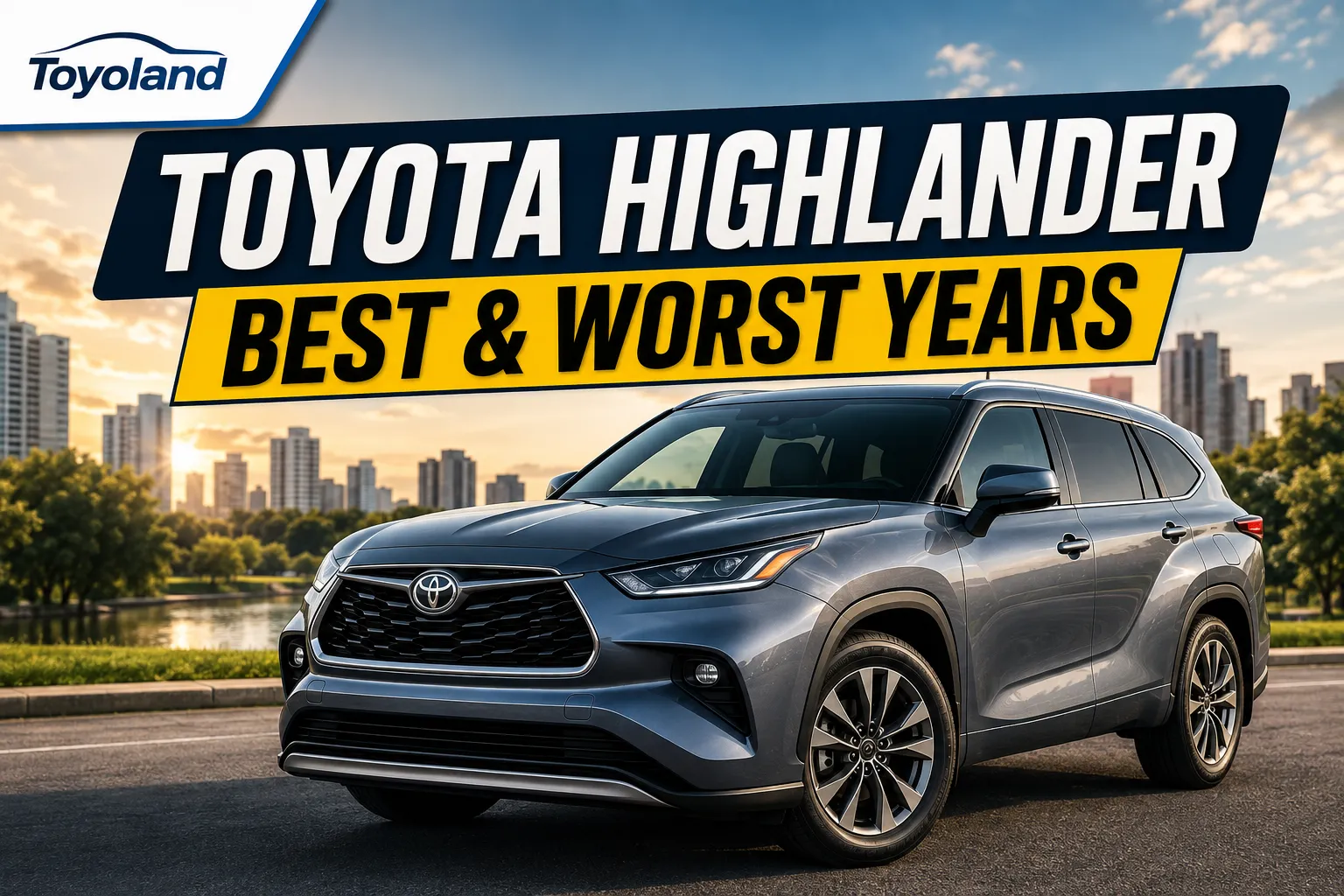

The Toyota Highlander has been a default three-row family SUV for two decades, and for good reason: it is roomy, comfortable, efficient for its size, and backed by Toyota’s reputation for going the distance. But “the Highlander is reliable” is a starting point, not a buying decision. Across the model years on the used market today, most are genuinely dependable — but one powertrain issue matters more than anything else on the spec sheet, and the popular “worst years” lists tend to get the details wrong.
This guide is built for one person: someone shopping for a used Highlander in 2026 who wants to know which years are the safest bets, which deserve a closer look, and why. Throughout, we separate what is documented (official recalls and Toyota support programs) from what is reported (patterns in owner-complaint databases) from our own editorial assessment. With the Highlander, that distinction is the whole game — because the headline concern is real, but it is narrower and more checkable than the internet suggests.
The quick answer
If you want the short version before the detail:
- Best established modern used choice (especially the hybrid): 2020–2022 (fourth generation) — roomy, well-equipped, strong safety scores, and enough ownership history to judge confidently. The hybrid is the standout because it avoids the gas V6’s eight-speed transmission; on a gas V6, verify the transmission (see below).
- Best older value: 2014–2016 (third generation, pre-facelift) — the proven 3.5L V6 with the older automatics, before the eight-speed arrived.
- Approach with caution: the 2017–2019 gas V6 — its eight-speed automatic (UA80) is a manufacturer-acknowledged concern for certain 2017–2018 vehicles (a support program and service bulletins, not a recall). Also check whether the specific car is covered by the fuel-pump recall, which affects certain — not all — of these vehicles.
- Solid but situational: 2001–2007, 2008–2013, and the newer 2023–2025 turbo models. The 2026 is the current model — too new to rank on long-term reliability, but notable for making AWD standard.
Notice there is no “avoid at all costs” year here. On the evidence, no Highlander model year earns a blanket condemnation — and the single biggest caution, the eight-speed transmission, is checkable on the specific car before you buy. The hybrid avoids it entirely.
Highlander generations at a glance
Reliability shifts with each redesign and each powertrain change, so it helps to know which generation a given year belongs to. For the broader picture of how reliability varies across the Toyota lineup, the Highlander is a useful case study in a fundamentally strong vehicle with one well-defined weak spot.
The generations that matter for today’s used market:
- First generation (2001–2007): the original car-based crossover, V6-powered, with a hybrid added for 2006. Durable but old; age dominates the decision now.
- Second generation, XU40 (2008–2013): larger, with a roomier third row, the strong 3.5L V6, and conventional automatics. A mature, dependable stretch after the 2008 first year.
- Third generation, XU50 (2014–2019): bolder styling, up to eight seats. A 2017 facelift brought a more powerful V6 — and, crucially, the eight-speed automatic that defines the caution below.
- Fourth generation (2020–present): the GA-K platform, more efficient powertrains, and modern safety tech as standard. For 2023, Toyota replaced the 3.5L V6 with a 2.4-liter turbocharged four-cylinder; the hybrid uses a 2.5-liter four-cylinder system.
The best Highlander years to buy
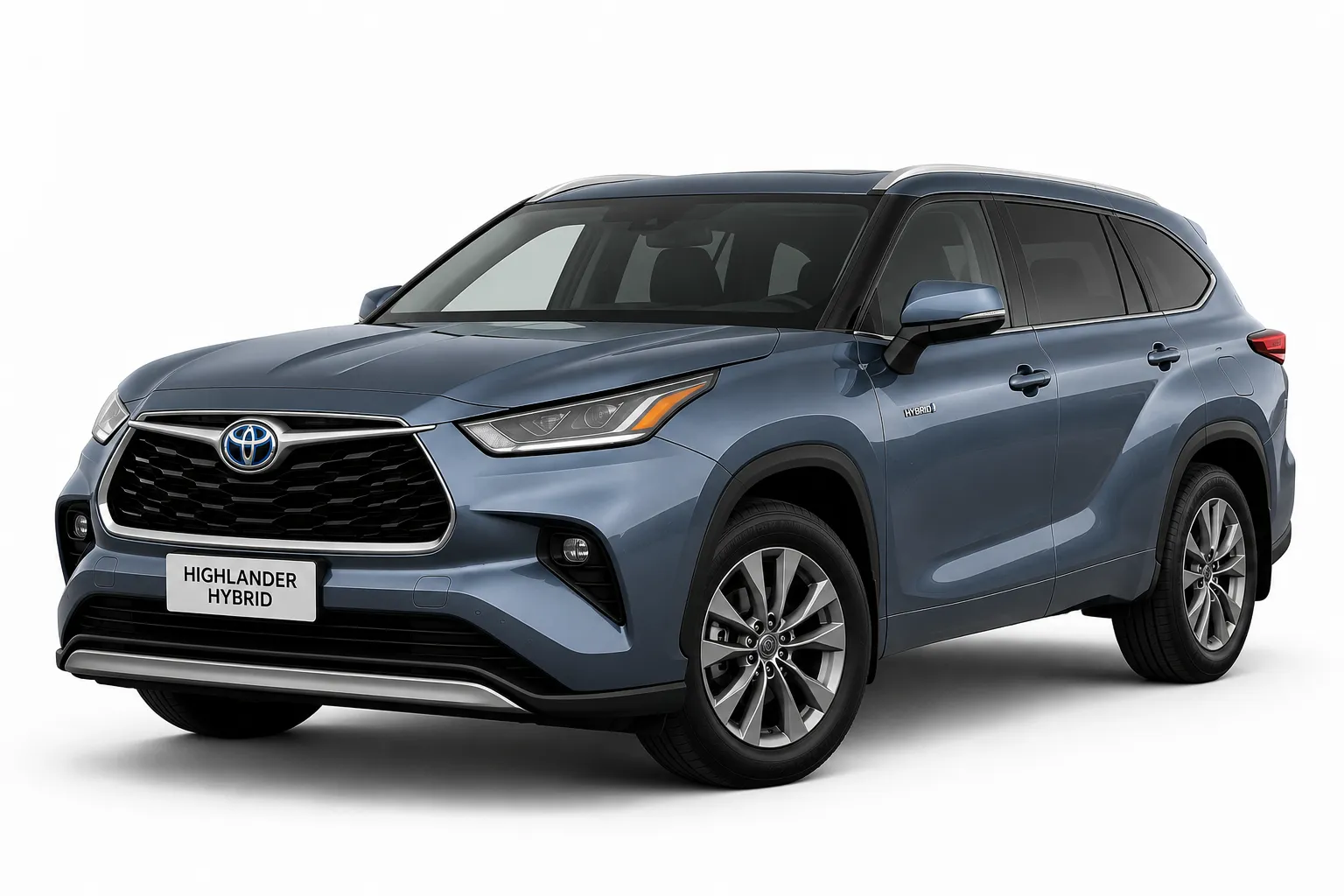
2020–2022: the best established modern used choice — especially the hybrid
For most buyers wanting a used Highlander in 2026, the 2020–2022 fourth-generation cars are the strongest choice — and the hybrid is the standout within that group. These are “established” in a specific sense: they belong to the current (fourth) generation, which continues through 2026, but they have enough accumulated ownership history to judge with confidence, unlike the newer 2023–2026 cars of the same generation. The 2020 redesign moved to the GA-K platform with more upscale styling, a quieter and more composed ride, and Toyota Safety Sense 2.5+ standard across the lineup (adaptive cruise, automatic emergency braking, lane-keeping), along with standard Apple CarPlay and Android Auto. Third-party reliability scores for these years are strong, and the Highlander has a strong IIHS record in this window: the 2022 Highlander SUV is listed as a Top Safety Pick+, though note it earned a Marginal in the updated moderate-overlap front test while its other crashworthiness results remained strong (confirm the exact award, year and trim before publishing, since IIHS awards depend on headlights and build date).
One important caveat that most “best years” lists skip: the gas V6 versions of these years still use the same eight-speed automatic (UA80) discussed below, and owner complaints and class-action litigation over that transmission extend into this generation. Be precise about the evidence, though: Toyota’s documented support program (ZJC) covered only certain 2017–2018 vehicles, so for a 2020–2022 gas V6 the concern is an owner-reported and litigation pattern rather than a manufacturer-acknowledged program for that specific year. That does not make a 2020–2022 gas V6 a bad buy — but treat the transmission check as essential. The hybrid versions of these years use an entirely different, well-proven powertrain and sidestep the concern altogether, which is exactly why we lean toward the hybrid here.
Who it’s for: family buyers who want modern safety and tech, and who will either choose the hybrid or properly vet a gas example.
 Toyota
2014–2016: the older-value pick
If your budget is tighter, the 2014–2016 third-generation cars (before the 2017 facelift) are the smart older buy. These use the proven 3.5-liter V6 paired with the older, well-regarded automatics — that is, before the eight-speed arrived — so they avoid the specific transmission concern that shadows the later third-generation cars. They are roomy, comfortable, and have a strong dependability record. As always with cars of this age, condition and maintenance history matter most, and you should still run a VIN recall check.
Who it’s for: value-focused family buyers who want three rows and Toyota durability without paying for the newest generation.
The years that deserve caution
A year appearing here does not make it a bad car. It means there is a specific, verifiable reason to inspect more carefully or confirm a repair before buying.
2017–2019 (gas V6): the eight-speed transmission — documented, but not a recall
This is the single most important thing to understand about the modern Highlander, and precision matters because most lists get it wrong in one direction or the other.
Documented (manufacturer program — certain 2017–2018, not a recall): the eight-speed automatic transmission introduced with the 2017 facelift — Toyota’s UA80 (UA80E front-drive / UA80F all-wheel-drive) — is the subject of a Toyota Customer Support Program (ZJC) covering certain 2017–2018 Highlander and Sienna vehicles. For qualifying VINs, it extends transmission warranty coverage to 10 years from the in-service date, tied to a specific defect: a washer tab meant to prevent a nut from loosening inside the transmission may not have been sufficiently bent during assembly. Toyota also issued multiple technical service bulletins (for example, T-SB-0160-18) addressing whine, harsh or delayed shifting, warning lights, and power loss. Importantly, this is a support program and service-bulletin matter, not a safety recall, and the ZJC coverage applied only to specific VIN/serial ranges within certain 2017–2018 vehicles — which is precisely why owners left outside that window filed class-action lawsuits.
Reported (2017 onward, including later gas V6 years): beyond the vehicles covered by the ZJC program, owners across 2017 onward — including the 2020–2022 gas V6 — have reported a high-pitched whine (often likened to an airplane), hesitation, harsh shifts, and in some cases premature failure, sometimes after the standard powertrain warranty lapsed. These reports are consistent and well-documented in owner databases and litigation filings, but they are owner reports and legal allegations, not a manufacturer defect finding or support program for those later years. In short: certain 2017–2018 vehicles have a documented Toyota program; the broader pattern is reported.
Documented (separate recall — VIN-specific): independently of the transmission, certain Highlanders of this era are covered by Toyota’s large low-pressure fuel-pump recall (a Denso fuel-pump impeller that can fail and cause a stall). Be precise here: the original filing (NHTSA 20V-012, January 2020) named certain 2018–2019 Highlanders — roughly 375,850 vehicles built between November 2017 and July 2019 — and a later expansion campaign (20V-682) brought in certain 2017 vehicles. These are identified by VIN and production range, so never assume every 2017–2019 Highlander is affected; verify the specific VIN through NHTSA and Toyota’s lookup, and confirm the free remedy was completed if it applies.
Editorial assessment: treat the 2017–2019 gas V6 as buy-with-care, not never-buy. If you are looking at one, this is the plan: check the VIN/serial against Toyota’s recall-and-campaign lookup to see whether the ZJC program or any TSB work applies and was performed; on the test drive, listen specifically for transmission whine and feel for hesitation or harsh shifts at 25–45 mph; confirm the fuel-pump recall is closed; and budget conservatively, since an out-of-coverage transmission repair can be expensive. A clean, documented example can serve for years — and the hybrid of the same era avoids the eight-speed altogether.
- The 2017 facelift brought a more powerful 3.5L V6 and updated styling and tech.
- Fundamentally roomy, comfortable, and well-equipped family SUV with strong safety scores.
- Qualifying 2017–2018 vehicles may carry extended UA80 transmission coverage (10 years) under Toyota's ZJC support program.
- UA80 eight-speed automatic: documented support program (ZJC) for certain 2017–2018 vehicles plus TSBs (whine, harsh/delayed shifts, power loss) — but NOT a recall, and coverage is VIN-specific; out-of-coverage repairs can be costly.
- Certain (not all) 2017–2019 vehicles are within the documented low-pressure fuel-pump safety recall (20V-012 / expansion 20V-682) — verify by VIN.
- Requires a transmission-focused test drive and a VIN/serial check before purchase; the hybrid avoids the concern.
2008: a first-year, age-related caution
The 2008 Highlander launched the second generation and, as often happens with first-year redesigns, carries more recall activity than the settled years that followed — Consumer Reports’ record lists 13 NHTSA recall campaigns for the 2008 model year. A recall count is not by itself a reliability verdict (many recalls are quick, free fixes), but it is a reason for extra diligence on a first-year car this old. Today the bigger factor is simply age: these cars are old enough that condition and history dominate the decision. Editorial assessment: not an “avoid,” but if you are considering one, treat it like any 15-plus-year-old vehicle — inspect thoroughly, confirm all recalls are closed by VIN, and weigh whether a slightly newer 2009–2013 car is the better value.
Highlander Buying Snapshot by Era
| Era | Verdict | Why | Watch for |
| 2014–2016 (3rd gen) | Good — older value | Proven 3.5L V6; older automatics (pre-8-speed) | Age/condition; run VIN recall check |
| 2020–2022 (4th gen) | Best established — esp. hybrid | GA-K platform; TSS 2.5+; CarPlay/Android Auto; strong safety; proven ownership data | Gas V6 uses UA80 8-speed (reported) — verify; hybrid avoids it |
| 2017–2019 (3rd gen, gas V6) | Caution | UA80 8-speed: ZJC program (certain 2017–2018) + TSBs, not a recall; fuel-pump recall on certain VINs | Transmission whine/shifts; VIN check for ZJC + recall |
| 2023–2025 (4th gen, turbo) | Good — newer | 2.4L turbo-four (265 hp / 310 lb-ft) replaced V6; 8-speed Direct Shift; often under warranty | Newer engine+transmission combo, less long-term data |
| 2026 (4th gen, current) | Too new to rank | Carryover; AWD now standard; LE dropped (XLE new entry) | New-vehicle pricing; unproven long-term |
What about the newest turbo models (2023–2025)?
For 2023, Toyota made the Highlander’s biggest recent powertrain change: it dropped the long-serving 3.5-liter V6 in favor of a 2.4-liter turbocharged four-cylinder. Per Toyota, the new engine makes 265 horsepower and 310 lb-ft of torque (Toyota’s original 2023 announcement listed 309 lb-ft; its current materials list 310) — 30 fewer horsepower than the V6 but more torque, which you feel at everyday speeds. It pairs with an eight-speed “Direct Shift” automatic. One important point of precision: this is a newer engine-and-transmission combination, so it should not be lumped in with the earlier V6’s documented transmission history — the Toyota support program (ZJC) discussed above is bounded to certain 2017–2018 V6 vehicles and should not be assumed to apply to the turbo. The trade-off with any newer powertrain is simply less accumulated long-term reliability data, though these cars are often still under warranty, which cushions the early-years risk.
For a used buyer, the clearest way to frame the 2023-onward choice is gas turbo versus hybrid. The gas turbo brings strong torque, is easier to find, and returns a Toyota-estimated 24 mpg combined. The hybrid uses Toyota’s long-proven hybrid architecture with an eCVT (not the gas eight-speed), returns roughly 35–36 mpg combined depending on year and drivetrain, and is the stronger fit for buyers prioritizing long-term running costs and drivetrain peace of mind. If you want the most proven powertrain overall, the hybrid remains the safest bet, and a well-kept 2020–2022 V6 (properly vetted for its transmission) is a known quantity.
The 2026 Highlander: too new to rank
We deliberately do not give the 2026 Highlander a Best or Worst verdict, because meaningful long-term reliability data for a current-model-year car simply doesn’t exist yet — ranking it either way would be guessing. For completeness, here is what is actually confirmed. According to Toyota, the 2026 Highlander is largely a carryover, with one headline change: all-wheel drive is now standard across every grade (previously the XLE and some other gas grades were front-wheel drive with AWD optional). Toyota also simplified the line-up and dropped the entry-level LE trim, making the XLE the new starting point — which pushes the entry price up. The powertrains carry over: the 2.4-liter turbo-four (265 horsepower, 310 lb-ft) on gas models and the 2.5-liter hybrid (243 system horsepower, a manufacturer-estimated 35 mpg combined), with Toyota Safety Sense 2.5+ standard.
For a used-focused buyer, the practical takeaway is simple: the 2026 is the car to cross-shop if you want the newest example and standard AWD, but it carries new-vehicle pricing and an unproven-by-time record. The same logic as the rest of this guide applies — the gas models use the newer turbo and eight-speed Direct Shift combination with limited long-term data, so the hybrid remains the lower-drivetrain-risk choice. If long-term dependability is your priority over having the latest model, a proven 2020–2022 hybrid still makes the stronger case.
Gas, V6, or hybrid? What used Highlander buyers should weigh
The Highlander has offered a hybrid since 2006, and for used buyers it is more than a fuel-economy play — it is also a way around the eight-speed transmission concern, because the hybrid uses a different powertrain. If efficiency and a robust drivetrain both matter to you, the hybrid is worth a serious look; it is also worth understanding what to know about Toyota hybrid battery life before you buy, since that is the question most hybrid shoppers ask first.
If you are still weighing the Highlander against other three-row options, see our guide to the best family SUVs, and for hybrid-specific cross-shopping,
the best hybrid SUVs to consider. Buyers open to a smaller, less expensive SUV may also want our
Common problems to check before you buy
Regardless of year, a short, targeted inspection protects you more than any online ranking. Prioritize these:
- Transmission (2017 onward, gas V6): on the test drive, listen for a high-pitched whine and feel for hesitation or harsh shifting at 25–45 mph. Check the VIN/serial against Toyota’s recall-and-campaign lookup for the UA80 ZJC program or applicable TSBs, and confirm whether any covered work was done.
- Fuel-pump recall (certain 2017–2019): this recall (20V-012 / expansion 20V-682) covers certain — not all — Highlanders of these years, identified by VIN and production range. Run the VIN through NHTSA and Toyota lookups to see whether it applies and, if so, confirm the free pump replacement was completed.
- Recall completion (all years): verify every open recall is closed — first-year 2008 cars and the newest models especially.
- Hybrid health (any hybrid year): the high-voltage battery is a long-life component, but age and history still matter; a hybrid-system health check is worthwhile.
- Transmission fluid service (gas 8-speed): despite “lifetime fluid” claims, many independent technicians recommend periodic fluid changes; ask whether it was done.
- Maintenance records overall: consistent servicing predicts how a specific Highlander will hold up far better than the model year alone.
Which Highlander is right for which buyer?
- Lowest budget, proven mechanicals: a clean 2014–2016 V6 (pre-eight-speed).
- Modern tech and safety, lowest drivetrain risk: a 2020–2022 hybrid.
- Modern gas V6, if properly vetted: a 2020–2022 gas model with a verified transmission and completed recalls.
- Newest, often still under warranty: a 2023–2025 turbo or hybrid, accepting less long-term data on the turbo.
- Considering a smaller, cheaper SUV: compare against the RAV4 (linked above).

Final verdict
The Highlander earns its reputation as a durable family SUV, and the used-buying decision comes down to one thing more than any other: the eight-speed automatic on gas V6 models from 2017 onward. That concern is real and, for certain 2017–2018 vehicles, documented at the manufacturer level (a support program and service bulletins); beyond that window it is a reported owner-complaint pattern. Either way it is not a safety recall, it is checkable on the specific car, and the hybrid avoids it entirely. For most people in 2026, a 2020–2022 hybrid is the modern sweet spot and a 2014–2016 V6 is the older-value pick, with the 2017–2019 gas V6 the main caution. No Highlander year earns an outright “avoid.” Buy on condition, verify the transmission and any applicable recalls, and lean toward the hybrid if you want the lowest drivetrain risk — the Highlander’s underlying dependability, and what underpins Toyota’s dependability reputation, does the rest.