
Battery degradation is one of the most discussed and most misunderstood aspects of electric vehicle ownership. The fear of an expensive battery replacement has been a significant barrier to EV adoption since the technology entered the mainstream, and it has been stoked by early horror stories — mostly involving first-generation EVs with battery technology that has since been substantially improved. The honest answer in 2024 is considerably more reassuring than the fear suggests, though it comes with important caveats that prospective EV owners need to understand.
This guide is based on real-world battery degradation data from owner studies, independent research, and several years of personal observation of how different EV batteries behave across different usage patterns and climates.
How EV Batteries Degrade
All rechargeable batteries lose capacity over time and with use. This is a fundamental property of battery chemistry — each charge and discharge cycle causes minor structural changes at the electrode level that cumulatively reduce the battery’s ability to hold charge. The rate of this degradation depends on the battery chemistry, the charging behaviour, the ambient temperature, and the depth of discharge in each cycle.
For most modern EV batteries, the degradation curve is not linear. The largest capacity losses typically occur in the first 20,000–30,000 miles of ownership — after which the degradation rate slows considerably. An EV that loses 5–8% of its battery capacity in the first two years may only lose another 5–8% over the following five years.
Real-World Data: What Actually Happens to EV Batteries
The most comprehensive real-world battery degradation data available comes from studies of Tesla Model S and Model 3 fleets, which have accumulated the longest ownership periods of any widely sold modern EV. Analysis of Tesla vehicles with over 100,000 miles of ownership shows average battery capacity retention of approximately 88–92% — meaning the battery holds 88–92% of its original capacity after this mileage. At 200,000 miles, well-maintained examples show capacity retention of around 80–85%.
Nissan Leaf data from the first-generation model (2011–2017) showed faster degradation than Tesla, particularly in hot climates — the absence of active thermal management in the first-generation Leaf’s battery was a significant contributing factor. Second-generation Leaf models and virtually all current mainstream EVs include active thermal management that substantially improves longevity. The first-generation Leaf’s degradation issues should not be extrapolated to current EV technology.
Factors That Affect EV Battery Life
Charging behaviour
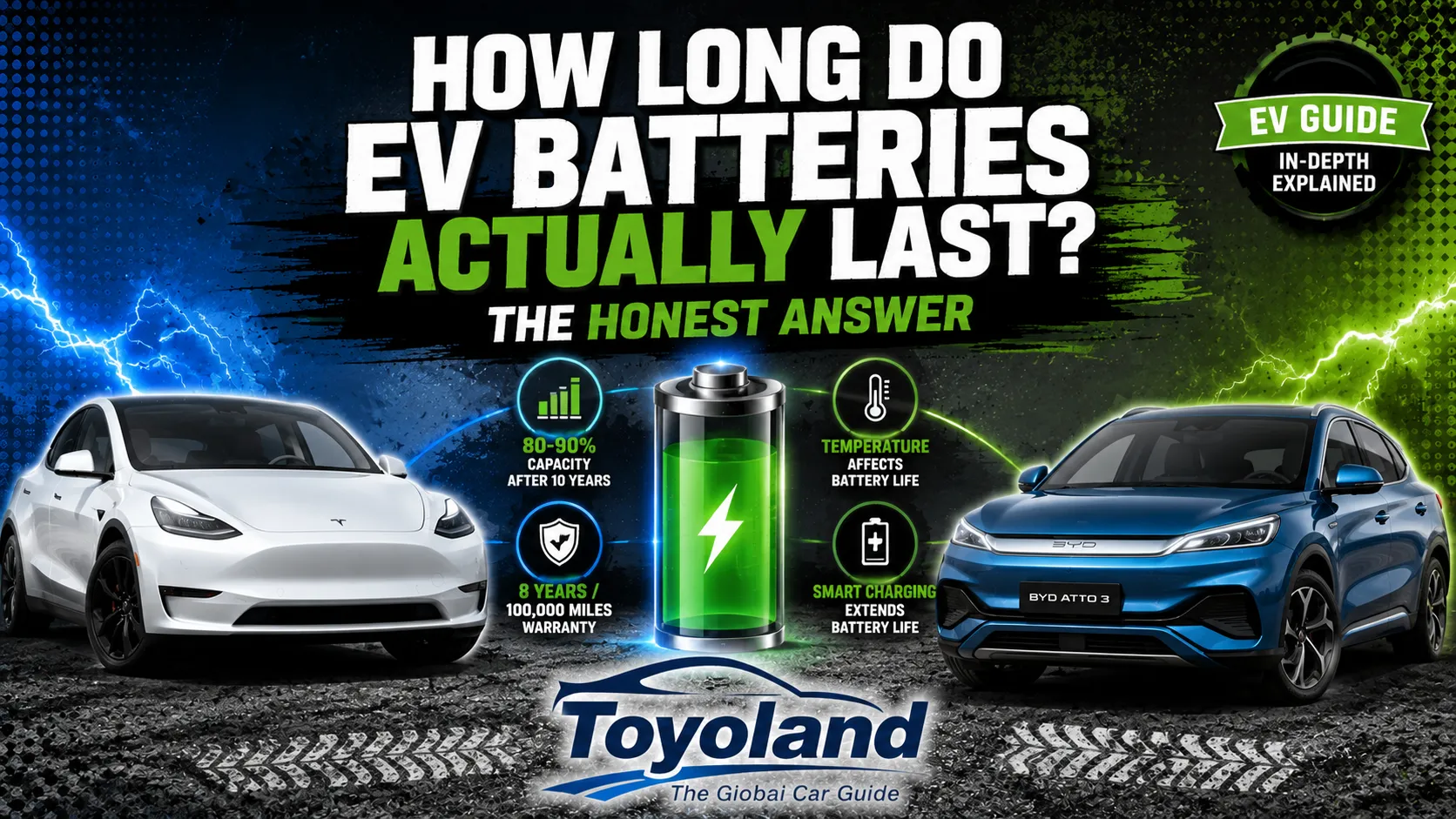
Regular use of DC fast charging — particularly rapid charging to 100% from very low states of charge — accelerates degradation more than home AC charging does. Most EV manufacturers recommend keeping the battery between 20% and 80% for daily charging and only charging to 100% for long journeys. Following this guidance meaningfully extends battery life.
Temperature
High ambient temperatures accelerate battery degradation. EVs operated in consistently hot climates degrade faster than equivalent vehicles in temperate climates. Active thermal management systems — standard in most current EVs — mitigate this by maintaining the battery within an optimal temperature range, but they cannot eliminate the effect entirely.
Battery chemistry
Lithium iron phosphate (LFP) batteries, used by BYD and in some Tesla standard range variants, degrade more slowly than nickel-manganese-cobalt (NMC) batteries. They can also be regularly charged to 100% without the degradation risk that NMC batteries carry at full charge. LFP chemistry’s slower degradation rate is one of its most significant practical advantages for long-term ownership.
Battery Warranties: What the Manufacturers Promise
Most major EV manufacturers now offer battery warranties of eight years or 100,000 miles with a guaranteed minimum capacity retention — typically 70% of original capacity. This means that if your battery degrades below 70% within the warranty period, the manufacturer is obligated to repair or replace it. In practice, battery degradation rarely reaches 70% within the warranty period in normal use, which means the warranty functions more as a confidence signal than a frequently exercised guarantee.
What Does a Battery Replacement Actually Cost
Battery replacement costs are the figure that most potential EV buyers fear, and the honest answer is that they vary enormously by vehicle, by the extent of replacement required, and by whether the work is done at a manufacturer facility or an independent specialist. Full battery pack replacements for popular EVs currently range from approximately $5,000 to $20,000 depending on the vehicle. These costs are falling as battery technology matures and as more second-life and refurbished battery options enter the market.
The relevant context is that full battery replacements are uncommon within normal ownership periods. The more common scenario is module replacement — replacing specific cells or modules that have degraded more than others — which costs considerably less than full pack replacement.
The Bottom Line
For most buyers purchasing a current-generation EV from a mainstream manufacturer with active thermal management, the realistic expectation is 80–90% battery capacity retention over a ten-year, 150,000-mile ownership period. Full battery replacement within this period is unlikely for typical usage patterns. The degradation fear that has historically accompanied EV purchase consideration is substantially overstated relative to what real-world data shows for current battery technology.
The important caveats: charge behaviour matters — following manufacturer guidance on regular charging limits extends battery life. Climate matters — hot climates accelerate degradation. And battery chemistry matters — LFP batteries are genuinely more durable for long-term ownership than NMC alternatives.