
Here’s the joke the used-car market never quite gets: people avoid old Priuses because they’re scared of the hybrid battery — the single most over-engineered component in the car — and then buy one without ever looking at the EGR cooler, which is the part that actually kills engines. Twenty-five years of Prius production have produced a very specific list of what really fails, and almost none of it is what buyers worry about in the showroom.
This page works failure-mode-first: the mechanism, the years, what Toyota put on paper, what it costs, and how to check. The year-by-year buying verdicts live in our Prius best and worst years guide — the two pages are designed to be read together.
The one that kills engines: EGR clogging and the Gen-3 head gasket
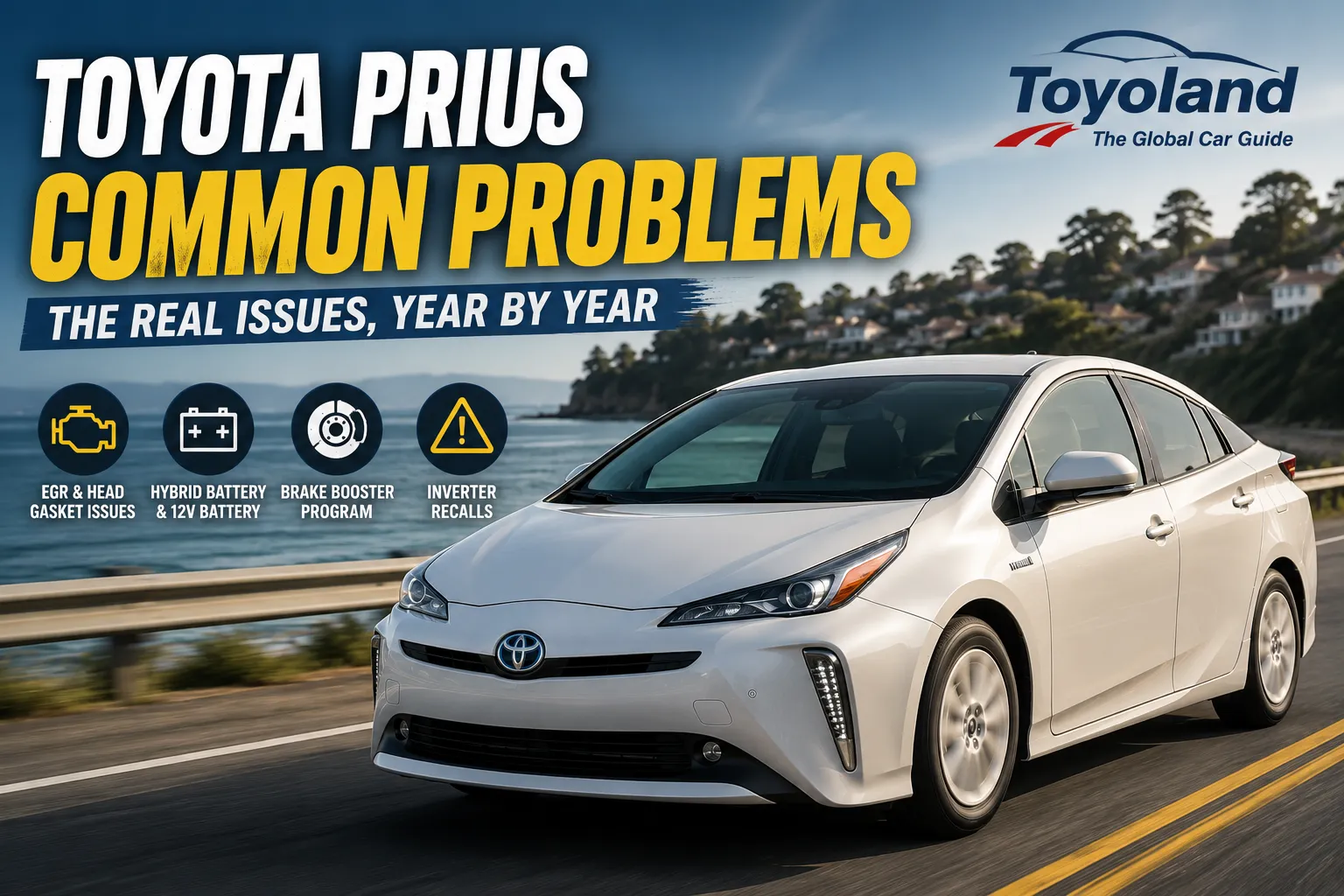
The third-generation Prius (2010–2015) recirculates exhaust through an EGR cooler to run efficiently — and over tens of thousands of miles, that cooler packs up with carbon like an old chimney. A clogged circuit spikes combustion temperatures in the cylinders that need the cooling most, and the head gasket eventually pays: the classic presentation is a cold-start shudder or misfire, unexplained coolant loss, then white smoke. By that point the conversation is a proper gasket job — often quoted against the value of the whole car.
Where does Toyota stand on paper? Adjacent and telling: an EGR warranty-enhancement program covered certain 2010–2012 cars, and a separate oil-consumption TSB acknowledged piston-ring wear on certain 2010–2014 engines — but the gasket failures themselves remain an owner-and-shop cluster, not a formal Toyota defect finding. The practical playbook hasn’t changed in a decade: on any Gen-3, ask when the EGR circuit was last cleaned (every ~50,000 miles is the known mitigation), pull the dipstick, watch the coolant reservoir over a week of ownership, and treat any cold-start shudder as a stop sign, not a quirk. A Gen-3 with a clean EGR history and stable fluids is a fine cheap car; one with a mystery coolant habit is someone else’s project.
- EGR maintenance (~every 50k) is cheap insurance against the era's worst outcome — prevention genuinely works here.
- Inverter conditions may still be Toyota's bill under 23TE02/23TE03 — check before paying any shop.
- All five documented programs are VIN-precise, which makes any individual car's exposure knowable in one dealer visit.
- The head-gasket endgame (misfire, coolant loss, white smoke) usually costs more than the car is worth.
- Brake-booster symptoms are safety-tier — the one item on this page with no haggling path.
The inverter: the one where Toyota’s paper still pays
The power inverter — the electronics brick that shuttles energy between battery and motors — had documented trouble in the Gen-3 era: safety recalls on certain 2010–2014 cars, and then something genuinely unusual: Customer Confidence Programs 23TE02 and 23TE03, which cover specific inverter and intelligent-power-module conditions on certain 2010–2015 cars for up to twenty years with no mileage limit. Do the math on those dates: qualifying cars can still be inside coverage right now. That makes the dealer VIN check on any Gen-3 more than hygiene — it’s potentially a four-figure component still under Toyota’s umbrella. Symptoms of inverter distress (warning triangle, sudden power loss, a car that shifts to limp-EV behavior) go straight to a dealer, program list in hand, before any independent shop touches it.
Brakes: the non-negotiable
Gen-3 cars also carry a brake-booster/pump customer-support program (certain 2010–2015), and this is the one system where our rule is absolute: inconsistent pedal feel, a spongy first press, or any brake warning light is disqualifying until a dealer diagnoses it. Brake-assist behavior isn’t a negotiation item on a used hybrid — the regenerative-to-friction handoff already feels unfamiliar to new owners, and masking a real fault inside that unfamiliarity is how people get hurt. Test hard stops from cold on every Gen-3 you drive.
The Gen-2 quirks (2004–2009)
The generation that made the Prius a phenomenon is mechanically honest at this age, with two known electrics. The combination meter — the digital strip that includes the speedometer — can black out, sometimes intermittently, which turns a $150 used-part fix into a genuine safety annoyance until it’s done; make sure it lights reliably, every time, cold and hot. And 2007-era cars logged a wave of headlight complaints (lights cutting out intermittently on HID-equipped cars) — check both at a night viewing. Everything else on a Gen-2 is age and records.
The batteries — both of them
Two batteries, two very different stories. The hybrid pack ages with time, heat and miles rather than failing by defect; a tired one telegraphs itself through rapid charge-gauge swings and slipping fuel economy, and repair options now run from cell-level fixes to quality refurbished packs at a fraction of old dealer pricing. The full lifespan-and-cost picture lives in our Toyota hybrid battery guide — read it before you let a seller’s “battery’s fine” stand in for a scan. Meanwhile the humble 12-volt auxiliary battery causes more actual roadside confusion than the big pack ever will: it’s small, it ages fast, and when it dies the car does a convincing impression of a dead hybrid. Test it at inspection; replace it cheerfully.
The 2 a.m. problem: catalytic-converter theft
Not a defect — a target on the car’s back. Gen-2 and Gen-3 Priuses carry converters rich enough in precious metals that thieves have made them a specialty, and a replacement runs $1,500–2,500-plus on cars often worth little more. On any used example: look underneath (original cat, aftermarket replacement, or fresh weld marks that tell a story), and price a shield into ownership if you park on the street. Insurance histories mentioning a prior theft aren’t disqualifying — but they explain aftermarket parts you’ll want verified as compliant.
Prius Problems at a Glance
| Car Name |
Spec Label
|
Spec Value
|
|---|---|---|
| Gen 2 (2004–2009) | Issue / Tier / Action | Combination meter, headlights / Reported / Power-on + night check |
| Gen 3 (2010–2015) | Issue / Tier / Action | EGR→gasket, oil TSB, inverter, brakes / Documented programs + reported cluster / EGR history, VIN programs, brake test |
| All generations | Issue / Tier / Action | Hybrid pack aging, 12V, cat theft / Condition + ownership reality / Scan, test, look underneath |
| Gen 4 (2016–2022) | Issue / Tier / Action | Minimal / --- / Routine VIN hygiene |
| Gen 5 (2023+) | Issue / Tier / Action | Routine remedied recalls / Documented, minor / VIN sweep; young record |
What about Gen 4 and Gen 5?
Refreshingly little. The 2016–2022 fourth generation left the Gen-3 cluster behind — its record is the reason it anchors our year guide’s recommendation — and the 2023-onward fifth generation has shown only routine, remedied recalls so far, with the honest caveat that its long-term book is still being written. On both: normal VIN hygiene, the 12V test, and the battery-condition scan cover it.
The pre-purchase routine
- Gen 3 (2010–2015): EGR service history; dipstick + top-up habits; cold-start listen for shudder; coolant level watch; hard brake test from cold; dealer VIN check for 23TE02/23TE03 and the inverter recalls.
- Gen 2 (2004–2009): combination meter lights reliably; both headlights at night; records.
- All years: hybrid-battery scan (not a verbal assurance); 12V battery test; underneath look at the converter; open-recall VIN sweep.
- Gen 4/5: the short list above — and enjoy the shortest problem sheet in this series.
The bottom line
The Prius fails in specific, knowable places — an EGR cooler you can clean, an inverter Toyota may still cover, a brake system you test in one drive, two batteries you scan in minutes, and a converter you check with a flashlight. None of it requires faith and all of it beats the folklore. Do the checks, buy the records, and the Prius remains what it’s been for two decades: the cheapest reliable miles in the entire Toyota lineup.
And if you’re weighing those cheap miles against going fully electric, our hybrid-versus-EV cost guide runs the numbers.