
Here’s what surprises people who read enough of our model guides back to back: the method never changes. Whether it’s a $6,000 Corolla or a $70,000 Land Cruiser, the buyers who end up happy do the same five things in the same order — and the expensive mistakes we’ve documented across the entire Toyota lineup almost all trace to skipping one of them. This page is that method, written once, properly — plus the directory that routes you to the right model guide for the deep detail.
Step 1: Pick the era, not the car
Toyota’s reputation is real, but it isn’t evenly distributed. Every model we’ve studied has golden windows — years where the engineering, the recalls and the owner records all align — and soft years where they don’t. The single biggest upgrade to your odds costs nothing: decide your target model years before you open a listings app. Shortlist two or three from the model’s guide, and treat anything outside them as needing a reason. Falling in love with a specific car first, then rationalizing its year, is how people end up owning the one weak vintage of an otherwise great machine.
Step 2: Run the VIN before the test drive
Two free lookups change everything. Toyota’s owner site and NHTSA’s recall tool both take a VIN and return open recalls in seconds — and an open safety recall (an unrepaired airbag inflator, an unaddressed fuel pump) is a hard stop until closed, not a negotiating point. Then there’s the layer most buyers never learn exists: Customer Support Programs and warranty enhancements, Toyota’s quieter coverage for known issues, surfaced by a dealer VIN history check. Some run astonishingly long — certain Prius inverter coverage extends up to twenty years with no mileage cap — which means a dealer visit can occasionally reveal that a four-figure component on the car you’re considering is still Toyota’s problem, not yours.
Step 3: Do the model-specific check
Generic inspections catch generic problems. What actually protects you is the one or two checks specific to the model in front of you — the ones our problems pages exist to teach. A few examples of how different they are: older body-on-frame trucks live or die by a frame inspection on a lift; certain four-cylinder eras get a dipstick-and-top-up interview for known oil consumption; one family of V6s has a specific oil line to visually confirm; some trucks get a cold-start listen for an emissions pump; certain years get a 15–25 mph transmission feel test. Every model directory entry below leads to the exact routine — ten minutes of reading that regularly saves four-figure surprises.
- Documentation converts unknown risk into known, negotiable cost — the highest-value filter in used buying.
- Receipts reveal the owner: fluid habits, recall closures, and whether known model items were addressed.
- A documented high-miler has proven the exact years and systems you're worried about.
- Low-mile mystery cars carry silent risk that no odometer can disclose — and they price higher on less information.
- Records can be curated; cross-check big claims (frame work, engine jobs) against the paper and the part.
Step 4: Buy records, not odometers
Across every model in this series, one filter outperforms all others: documentation. A 150,000-mile car with a folder of receipts is a known quantity — you can see the timing service, the fluid habits, the recall closures, the owner who cared. A 90,000-mile car with no history is a lottery ticket wearing a nicer number. Service records convert unknown risk into known cost, and known cost is negotiable. When forced to choose, take the paper trail every time — and treat a seller’s reluctance to share history as information in itself.
Step 5: Match the safety era to your household
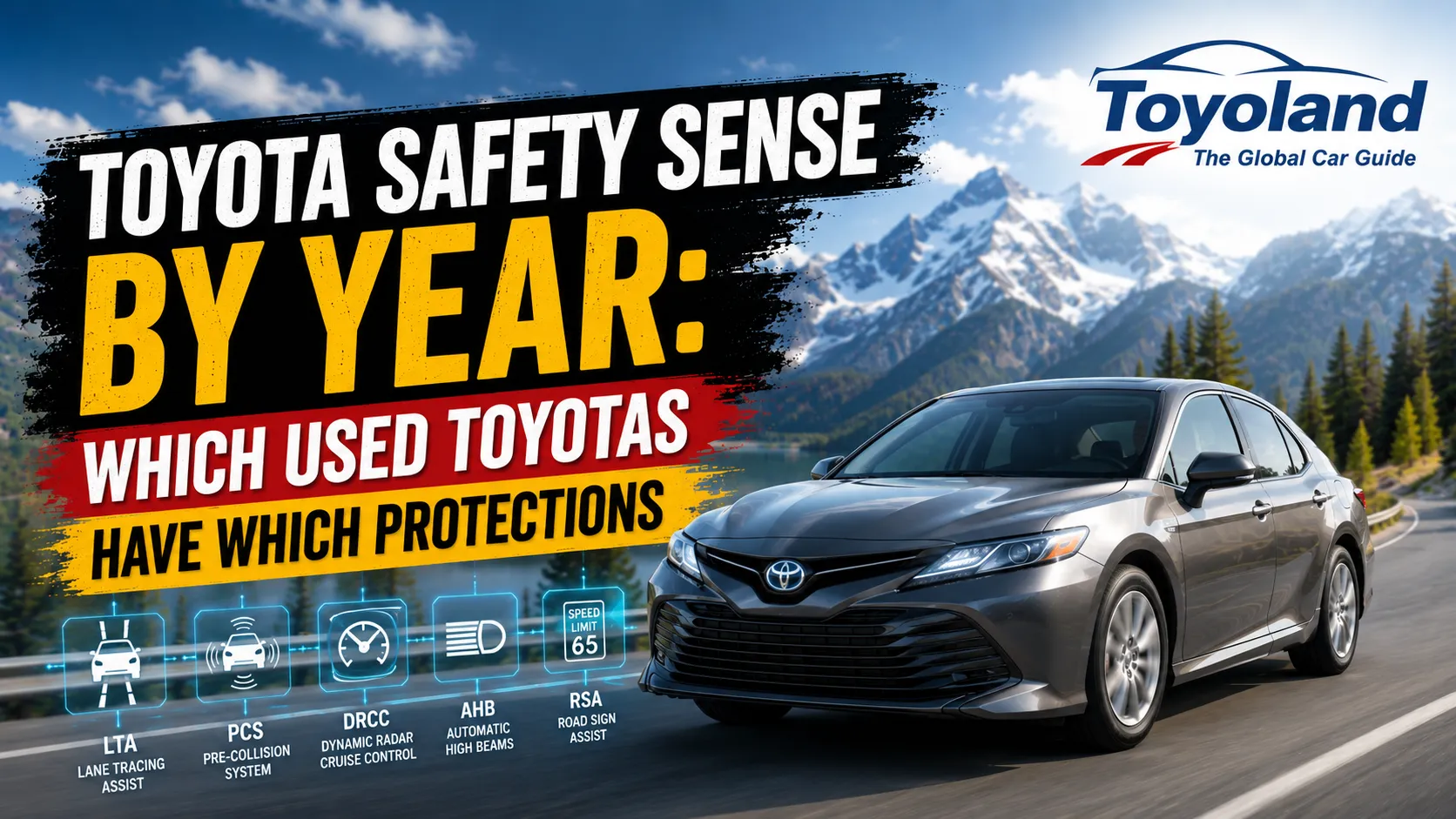
Mechanical years aren’t the only years that matter. Toyota Safety Sense — automatic emergency braking, lane keeping, adaptive cruise — arrived in 2015 and stepped up meaningfully in 2018 and again in 2021, and which version a used Toyota carries depends on its model and year in ways that aren’t obvious from the window sticker. If you’re buying for a new driver, an aging parent, or a long-commute household, the safety generation can matter as much as the engine. Our Toyota Safety Sense by-year guide maps exactly which years of which models carry which protections.
Where to Start, by Buyer
| Car Name |
Spec Label
|
Spec Value
|
|---|---|---|
| Commuter on a budget | Start with / Then read | Corolla year guide / Prius year guide |
| Family, five seats | Start with / Then read | RAV4 year guide / Venza year guide |
| Family, seven seats | Start with / Then read | Highlander year guide / Sienna + Sequoia guides |
| Truck buyer | Start with / Then read | Tacoma year guide / Tundra year guide |
| Keep-it-forever buyer | Start with / Then read | 4Runner year guide / Land Cruiser year guide |
| Sedan traditionalist | Start with / Then read | Camry year guide / Avalon year guide |
The model directory: start here
Every guide below applies the five steps to one model — golden years, soft years, and the specific checks that decide the purchase.
- Sedans: the Camry year guide (the default answer), the Corolla year guide (the budget default), and the Avalon year guide (the closed-book flagship — discontinued, and better for it).
- SUVs and crossovers: the RAV4 year guide (the best-seller), the Highlander year guide (the three-row family answer), the Venza year guide (the quiet hybrid), the 4Runner year guide (the body-on-frame keeper), the Sequoia year guide (the family fortress), and the Land Cruiser year guide (the decades machine).
- Trucks: the Tacoma year guide and the Tundra year guide — including the frame chapters and the modern recall eras that make year choice decisive.
- Hybrids and the van: the Prius year guide (the cheapest reliable miles in the lineup) and the Sienna year guide (the family hauler with two non-negotiable checks).
Budgeting honestly
Purchase price is the entry fee, not the cost. Insurance, fuel and the model’s known wear items set the real monthly number — our fuel cost calculator turns any candidate’s thirst into a figure before you commit, and the best used cars under $20,000 shows where the value actually concentrates if the budget is fixed. Hybrid shoppers worried about battery costs should read our hybrid battery guide before paying a gas-model premium out of fear — the anxiety is two decades out of date.
The bottom line
Buy the era, run the VIN, do the model’s check, take the records, match the safety year — five steps, maybe an hour of homework, and the difference between inheriting someone’s problem and buying the car Toyota’s reputation actually describes. If this is your first car purchase entirely, our first-car buying guide walks the whole process from budget to paperwork; otherwise, pick your model above and go deep.